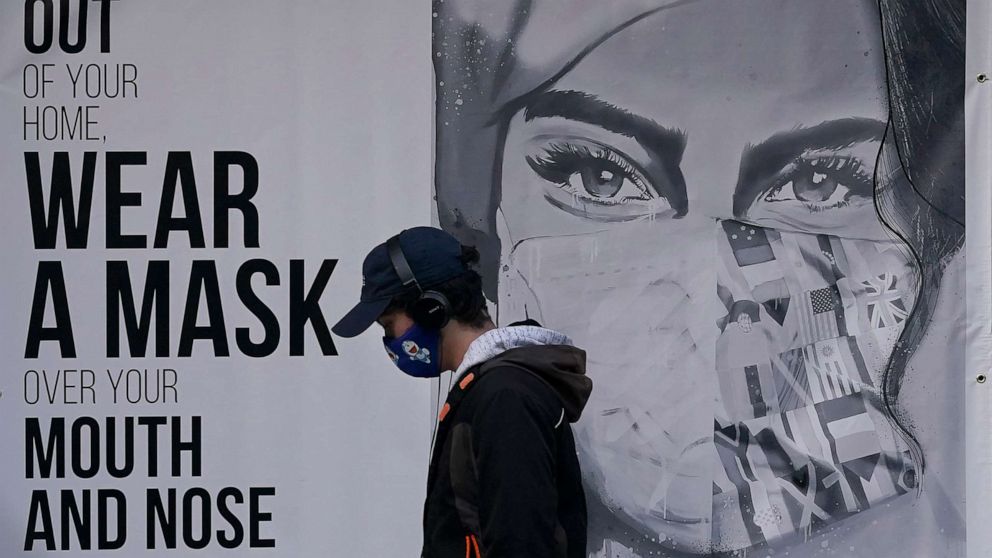
A pandemic of the novel coronavirus has now infected more than 66.4 million people and killed over 1.5 million worldwide, according to real-time data compiled by the Center for Systems Science and Engineering at Johns Hopkins University.

A pandemic of the novel coronavirus has now infected more than 66.4 million people and killed over 1.5 million worldwide, according to real-time data compiled by the Center for Systems Science and Engineering at Johns Hopkins University.
Colorado's first gentleman Marlon Reis, who was diagnosed with the coronavirus last week with his partner Gov. Jared Polis, was hospitalized Sunday after his condition worsened, the governor's office said.

Reis experienced a "slightly worsening cough and shortness of breath," on his eighth day of the virus, according to the governor's office.
Polis drove Reis in his own vehicle to the hospital, according to the governor's office.
"Governor Polis is not experiencing any additional symptoms at this time," the governor's office said in a statement.
-ABC News' Clayton Sandell
The U.S. has hit another record level for coronavirus related hospitalizations, according to the COVID Tracking Project.
Our daily update is published. States reported 1.6 million tests, 177k cases, and 1,138 deaths. 101,487 people are currently hospitalized with COVID, another new record. Averaged across the last 7 days, each of our core metrics is at record levels. pic.twitter.com/z9RbCtA8Zo
— The COVID Tracking Project (@COVID19Tracking) December 7, 2020
There are at least 101,487 Americans hospitalized as of Sunday evening, the tracking project tweeted.
There were over 176,000 new cases and 1,138 new deaths recorded Sunday, according to the health data.
The seven-day average for the tracking project's main metrics also saw new record highs. The seven-day average for new cases was 191,736, for deaths were 2,171 and hospitalizations were 99,939, according to the health data.
The U.S. has now reported over 100,000 cases every day for more than a month straight, and over 200,000 cases for the last three consecutive days, according to health data.
The country reported more than 1.3 million COVID-19 cases in the last week, which is more than any other week on record, the health data showed.
In the last month, the average number of daily cases has doubled.
The U.S. is currently averaging over 186,793 new coronavirus cases every day, the highest the average has been since the beginning of the pandemic, according to health data.
Since last week, there have been nearly new 15,000 COVID-19 related deaths, with five days over the 2,000 mark, the health data showed.
That is roughly equivalent to 88 COVID-19 related deaths reported every hour.
The U.S. is currently averaging 2,123 reported COVID-19 deaths a day, that average has increased by 142% since last month, according to the health data.
Hospitalizations continue to surge to unprecedented levels, with over 101,000 patients currently hospitalized with COVID-19 across the country, according to the health data.
Current hospitalizations have nearly doubled in the last month, the health data showed.
-ABC News' Arielle Mitropoulos
Los Angeles County set a new record number of coronavirus cases Sunday, the Health Department said.
The county saw 10,528 new cases and 23 new deaths, according to the Health Department. There are 2,855 people currently hospitalized, the Health Department said.
Los Angeles leads the country with total number of cases, 439,408, and total fatalities, 7,886, according to Johns Hopkins University's Coronavirus Resource Center.
As states begin dry runs for distribution of a COVID-19 vaccine, Pfizer and the federal government are still hammering out logistics around handling the company's candidate, ABC News has learned.
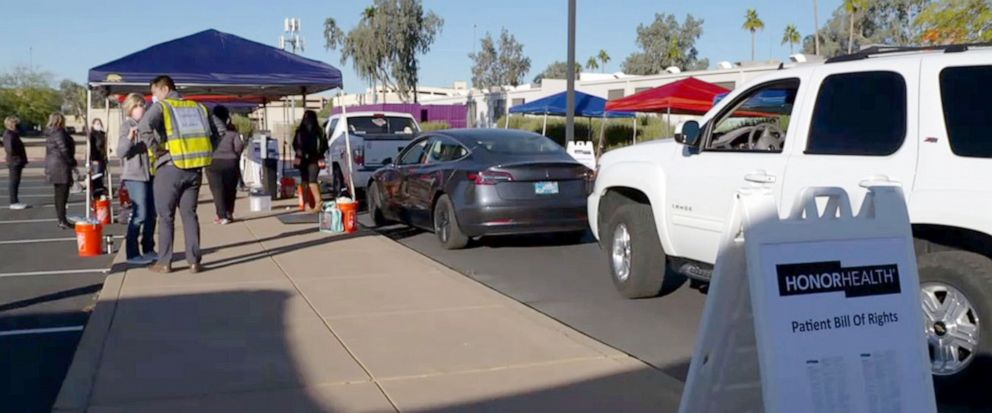
HonorHealth in Phoenix ran a simulation on Friday for how it would distribute a vaccine to health care workers once the FDA approves a candidate. But it was incomplete due to the remaining logistical questions.

After each vial of Pfizer's vaccine is removed from ultra-cold storage at minus 80 degrees Celsius, it is thawed, then diluted with saline by trained chemists who then portion it out into five separate syringes.
But some intricacies of the process are unknown, such as how many times the vaccine's shipping container can be opened, how much time can elapse between thawing and injection, and how the dose should be transported to the injection site.
The hospital is also uncertain how many doses it will receive and when, should the FDA authorize emergency use of Pfizer's vaccine.
Pfizer has not commented on the specific handling of the vaccine once it's taken out of the freezers and thawed.
-ABC News' Matt Gutman