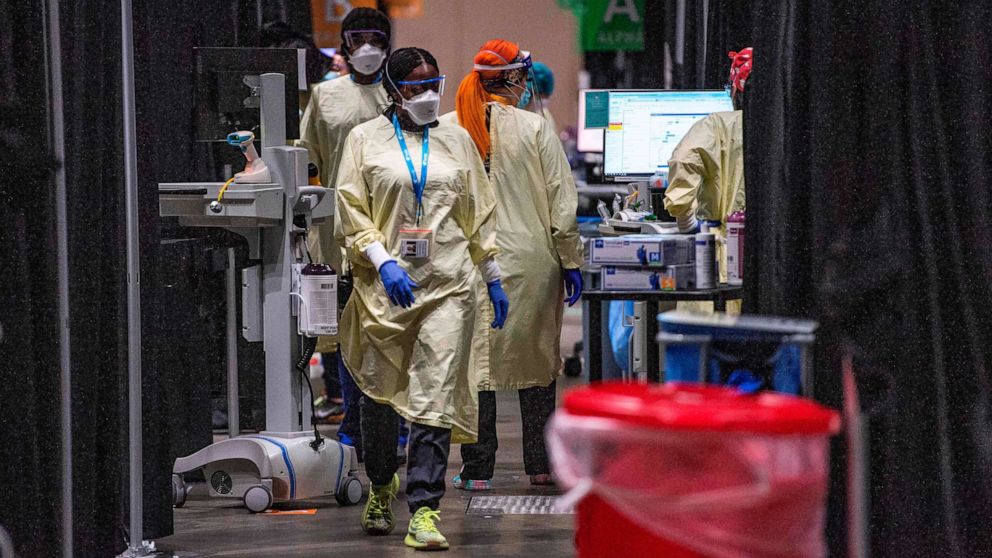
A pandemic of the novel coronavirus has now infected more than 105 million people worldwide and killed over 2.3 million of them, according to real-time data compiled by the Center for Systems Science and Engineering at Johns Hopkins University.
A pandemic of the novel coronavirus has now infected more than 105 million people worldwide and killed over 2.3 million of them, according to real-time data compiled by the Center for Systems Science and Engineering at Johns Hopkins University.
There were 96,003 newly confirmed cases of COVID-19 reported in the United States on Sunday, marking the first day the country has seen under 100,000 new cases since Nov. 2, according to data compiled by The COVID Tracking Project, a volunteer-run effort to track the U.S. outbreak.
Meanwhile, the data shows the nationwide number of COVID-19 patients in hospitals continues to decrease. There are currently 81,439 people hospitalized with COVID-19 in the U.S., the lowest number since Nov. 19.
An additional 1,474 deaths from COVID-19 were also reported nationwide on Sunday, according to The COVID Tracking Project.
However, the data is missing updates from a handful of states, some of which regularly do not report on the weekend and some of which are having technical difficulties.
According to The COVID Tracking Project, 41 states and Washington, D.C., have seen a decline in the seven-day average of new COVID-19 cases, while the rate in nine states is staying relatively the same.
Our daily update is published. States reported 1.5M tests, 96k cases, 81,439 people currently hospitalized with COVID-19, and 1,471 deaths. pic.twitter.com/4Y0v3YEcVS
— The COVID Tracking Project (@COVID19Tracking) February 8, 2021
Since the pandemic began, the U.S. has reported 26,996,534 confirmed cases of COVID-19, including 463,339 deaths, according to data compiled by Johns Hopkins University.
ABC News’ Celia Darrough and Darren Reynolds contributed to this report.
The battles over in-person learning between teachers and the school districts in Chicago and San Francisco may temporarily be over.
Chicago Mayor Lori Lightfoot announced in a press conference Sunday that "at long last" a tentative agreement has been reached. Students will return to the classroom in stages, with pre-K students starting on Feb. 11, kindergarten through fifth grades on March 1 and sixth through eighth grades on March 8.
It is unclear when high school students will be slated to return to in-person learning. Public schools in Chicago had been fully remote since the pandemic began last spring.
In San Francisco, teachers unions have agreed to return to in-person learning when the city progresses to the red tier, California’s second-least most restrictive level. The city is currently in the purple tier, the state's most restrictive mode in the reopening plan.
ABC News’ Meredith Deliso, Joshua Hoyos and Matthew Fuhrman contributed to this report.
The number of cases, hospitalizations and deaths are continuing to decline nationwide, according to a new report by the U.S. Department of Health and Human Services.
There has been a four-week downward trend of reported COVID-19 cases – resulting in a 50% decline since the peak on Jan. 8.
However, the rates of adult occupancy in intensive care units remain high in several states, the report found.
So far, 39,037,964 vaccine doses have been administered, with 9% of the population (30.3 million people) having received one or more doses and 3% of the population (8.3 million people) having received two doses.
Since President Joe Biden was sworn in on Jan. 20, 22,512,683 doses have been administered toward his 100 million goal.
ABC News’ Josh Margolin and Arielle Mitropoulos contributed to this report.
Cases of the more contagious U.K. variant of the COVID-19 virus is spreading rapidly through the U.S., as much as doubling every 10 days, a new study suggests.
The study has not peer reviewed, so it has not been scrutinized for inaccuracies or context by specialists.
It is still not known whether the U.K. variant is more virulent or deadly, but it is more transmissible. The Centers for Disease Control and Prevention warned last month that the U.K. variant could become predominant in the U.S. by March if spread the way it did in the U.K.
Vaccines don’t seem to be strongly impacted by the U.K. variant, but scientists are concerned about the efficacy of the vaccines against the South African variant.
-ABC News’ Eric Strauss
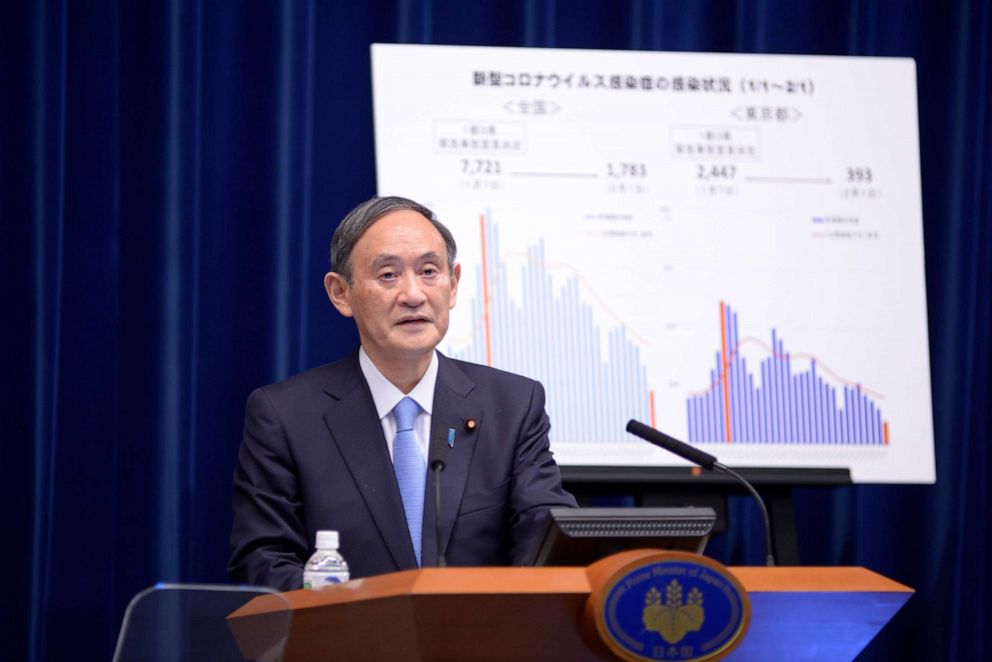
Japanese Prime Minister Yoshihide Suga has extended a state of emergency in Tokyo and nine surrounding prefectures for another month to further stem the spread of the novel coronavirus.
The declaration, however, was lifted in Tochigi prefecture, north of Tokyo, where the COVID-19 infection rate has eased.
"I regret that the declaration cannot be lifted across the nation at this time," Suga said Tuesday night in a televised address from his office in Tokyo.
The prime minister used a chart to show that Japan's daily number of newly diagnosed infections has declined from 7,721 on Jan. 7 to 1,783 on Feb. In Tokyo, that number has dropped from 2,447 on Jan. 7 to 393 on Feb. 1. According to the Japanese Ministry of Health, Labor and Welfare, there were 556 new cases of COVID-19 confirmed in the capital city on Tuesday.

Suga said the state of emergency could be lifted earlier than March 7 if the situation continues to improve. He noted that his government is hoping to begin a mass COVID-19 vaccination program as early as mid-February.
"Thanks to the cooperation of the people of Japan, we have seen a marked outcome," he said. "At this point in time, I need to ask the people to endure another round of the state of emergency so that positive outcomes can be solidified."
The move comes less than six months before the pandemic-delayed 2020 Summer Olympics are scheduled to open in Tokyo.
A state of emergency declaration gives the governors of those respective regions the authority to ask residents for cooperation in efforts to curb the spread of the virus. There are currently no legal ramifications for non-compliance.
Suga first declared a state of emergency in Tokyo and three neighboring prefectures on Jan. 7, before expanding the order to include more virus-hit areas.

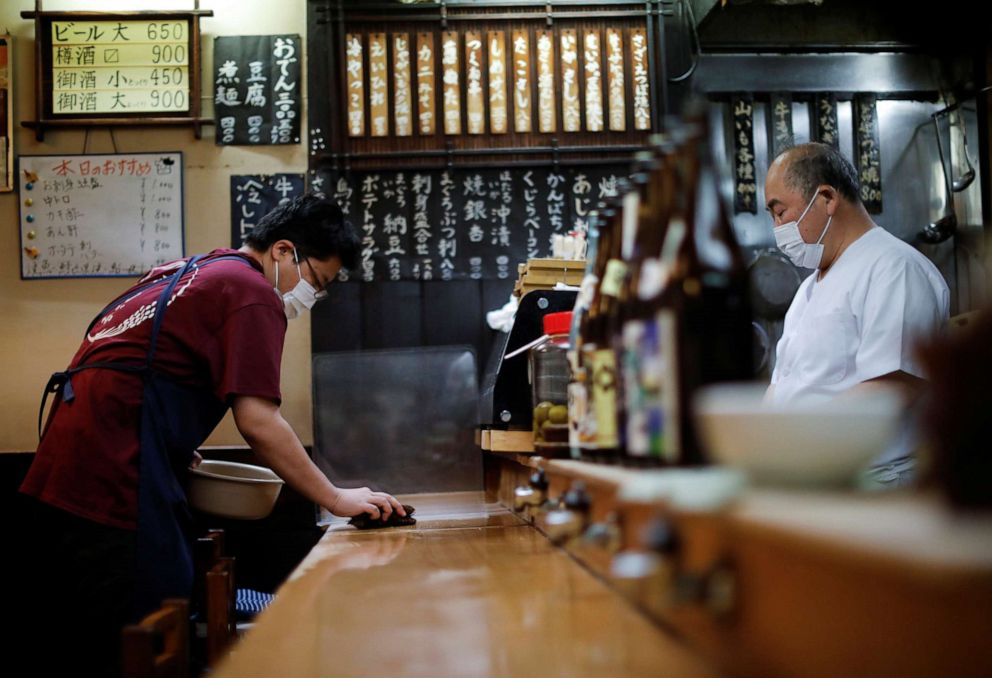
Under the state of emergency, Suga said governors will ask residents to refrain from dining out and to stay home after 8 p.m. unless for essential reasons. They will also ask companies to decrease the number of employees commuting to work by 70%.
Suga said bars and restaurants will be asked to stop serving alcohol by 7 p.m. and to close by 8 p.m. Governors may disclose the name of the businesses that don't comply, while those that do will be given 1.8 million Japanese yen ($17,000) per month.
Spectator events will be limited to an audience of 5,000 people. Schools will not be asked to close, according to Suga.
Suga's predecessor, Shinzo Abe, declared a nationwide state of emergency relatively early in the pandemic in April, which lasted for a month. At that time, residents were asked to reduce person-to-person contact by 80% and to practice "jishuku," or "self-restraint," by staying at home and closing non-essential businesses.
As of Tuesday, the Japanese Ministry of Health, Labor and Welfare has confirmed 392,475 cases of COVID-19 since the start of the pandemic, including 5,846 deaths.
ABC News' Anthony Trotter contributed to this report.