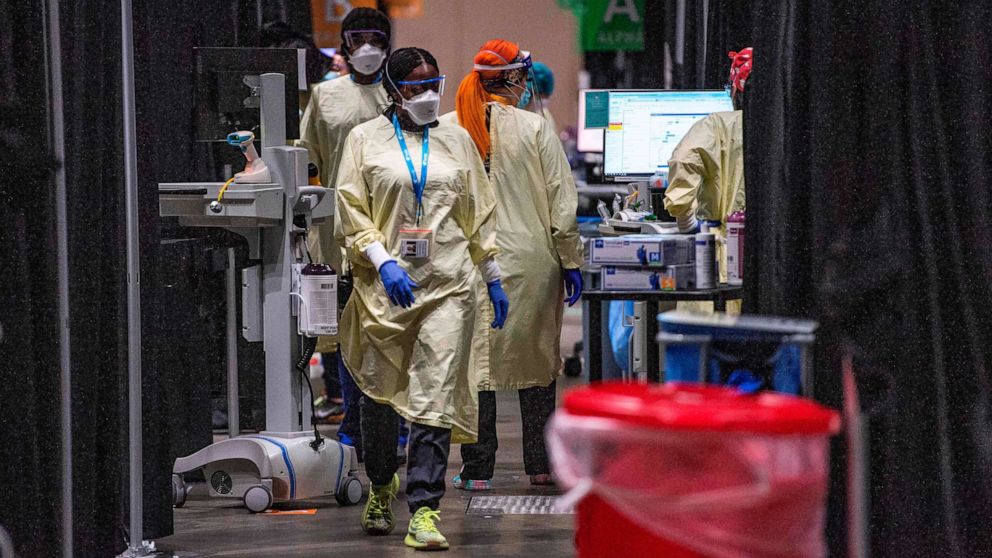
A pandemic of the novel coronavirus has now infected more than 105 million people worldwide and killed over 2.3 million of them, according to real-time data compiled by the Center for Systems Science and Engineering at Johns Hopkins University.
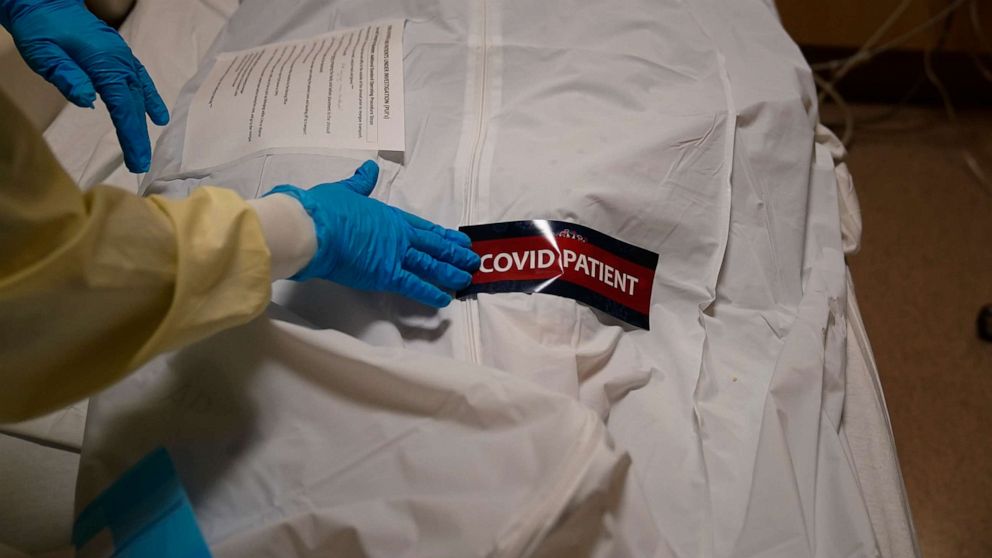
A pandemic of the novel coronavirus has now infected more than 105 million people worldwide and killed over 2.3 million of them, according to real-time data compiled by the Center for Systems Science and Engineering at Johns Hopkins University.
There were 96,003 newly confirmed cases of COVID-19 reported in the United States on Sunday, marking the first day the country has seen under 100,000 new cases since Nov. 2, according to data compiled by The COVID Tracking Project, a volunteer-run effort to track the U.S. outbreak.
Meanwhile, the data shows the nationwide number of COVID-19 patients in hospitals continues to decrease. There are currently 81,439 people hospitalized with COVID-19 in the U.S., the lowest number since Nov. 19.
An additional 1,474 deaths from COVID-19 were also reported nationwide on Sunday, according to The COVID Tracking Project.
However, the data is missing updates from a handful of states, some of which regularly do not report on the weekend and some of which are having technical difficulties.
According to The COVID Tracking Project, 41 states and Washington, D.C., have seen a decline in the seven-day average of new COVID-19 cases, while the rate in nine states is staying relatively the same.
Our daily update is published. States reported 1.5M tests, 96k cases, 81,439 people currently hospitalized with COVID-19, and 1,471 deaths. pic.twitter.com/4Y0v3YEcVS
— The COVID Tracking Project (@COVID19Tracking) February 8, 2021
Since the pandemic began, the U.S. has reported 26,996,534 confirmed cases of COVID-19, including 463,339 deaths, according to data compiled by Johns Hopkins University.
ABC News’ Celia Darrough and Darren Reynolds contributed to this report.
The battles over in-person learning between teachers and the school districts in Chicago and San Francisco may temporarily be over.
Chicago Mayor Lori Lightfoot announced in a press conference Sunday that "at long last" a tentative agreement has been reached. Students will return to the classroom in stages, with pre-K students starting on Feb. 11, kindergarten through fifth grades on March 1 and sixth through eighth grades on March 8.
It is unclear when high school students will be slated to return to in-person learning. Public schools in Chicago had been fully remote since the pandemic began last spring.
In San Francisco, teachers unions have agreed to return to in-person learning when the city progresses to the red tier, California’s second-least most restrictive level. The city is currently in the purple tier, the state's most restrictive mode in the reopening plan.
ABC News’ Meredith Deliso, Joshua Hoyos and Matthew Fuhrman contributed to this report.
The number of cases, hospitalizations and deaths are continuing to decline nationwide, according to a new report by the U.S. Department of Health and Human Services.
There has been a four-week downward trend of reported COVID-19 cases – resulting in a 50% decline since the peak on Jan. 8.
However, the rates of adult occupancy in intensive care units remain high in several states, the report found.
So far, 39,037,964 vaccine doses have been administered, with 9% of the population (30.3 million people) having received one or more doses and 3% of the population (8.3 million people) having received two doses.
Since President Joe Biden was sworn in on Jan. 20, 22,512,683 doses have been administered toward his 100 million goal.
ABC News’ Josh Margolin and Arielle Mitropoulos contributed to this report.
Cases of the more contagious U.K. variant of the COVID-19 virus is spreading rapidly through the U.S., as much as doubling every 10 days, a new study suggests.
The study has not peer reviewed, so it has not been scrutinized for inaccuracies or context by specialists.
It is still not known whether the U.K. variant is more virulent or deadly, but it is more transmissible. The Centers for Disease Control and Prevention warned last month that the U.K. variant could become predominant in the U.S. by March if spread the way it did in the U.K.
Vaccines don’t seem to be strongly impacted by the U.K. variant, but scientists are concerned about the efficacy of the vaccines against the South African variant.
-ABC News’ Eric Strauss
A staggering 5,078 fatalities from COVID-19 were registered in the United States on Thursday, marking a new single-day record, according to a real-time count kept by Johns Hopkins University.
It's the first time since the start of the coronavirus pandemic that the U.S. has recorded more than 5,000 deaths from the disease in a single day. Thursday's tally far exceeds the country's previous all-time high of 4,466 new deaths registered on Jan. 12, Johns Hopkins data shows.
There were also 122,473 new cases of COVID-19 confirmed nationwide on Thursday, down from a peak of 300,282 newly confirmed infections on Jan. 2, according to Johns Hopkins data.
COVID-19 data may be skewed due to possible lags in reporting over the Martin Luther King Jr. Day holiday weekend last month as well as during storm-related closures in some northeastern states earlier this week.
A total of 26,679,554 people in the U.S. have been diagnosed with COVID-19 since the pandemic began and at least 455,869 have died, according to Johns Hopkins data. The cases include people from all 50 U.S. states, Washington, D.C., and other U.S. territories as well as repatriated citizens.

Much of the country was under lockdown by the end of March as the first wave of pandemic hit. By May 20, all U.S. states had begun lifting stay-at-home orders and other restrictions put in place to curb the spread of the novel coronavirus. The day-to-day increase in the country's cases then hovered around 20,000 for a couple of weeks before shooting back up over the summer.
The numbers lingered around 40,000 to 50,000 from mid-August through early October before surging again to record levels, crossing 100,000 for the first time on Nov. 4, then reaching 200,000 on Nov. 27 before topping 300,000 on Jan. 2.
So far, the U.S. Food and Drug Administration has authorized two COVID-19 vaccines for emergency use -- one developed by U.S. pharmaceutical giant Pfizer and its German partner BioNTech, and another developed by American biotechnology company Moderna and the National Institute of Allergy and Infectious Diseases. More than 35 million vaccine doses have been administered nationwide, according to the latest data from the Centers for Disease Control and Prevention.