'Mad Men' Finale: The True Story Behind the Coca-Coca Ad
— -- Spoiler alert: This article contains information about the “Mad Men” series finale, “Person to Person.”
Don Draper sits on a hill overlooking the Pacific Ocean, meditating, finding peace and inspiration.
He smiles.
Footage -- and a song -- begins to play.
I’d like to buy the world a home, and furnish it with love ...
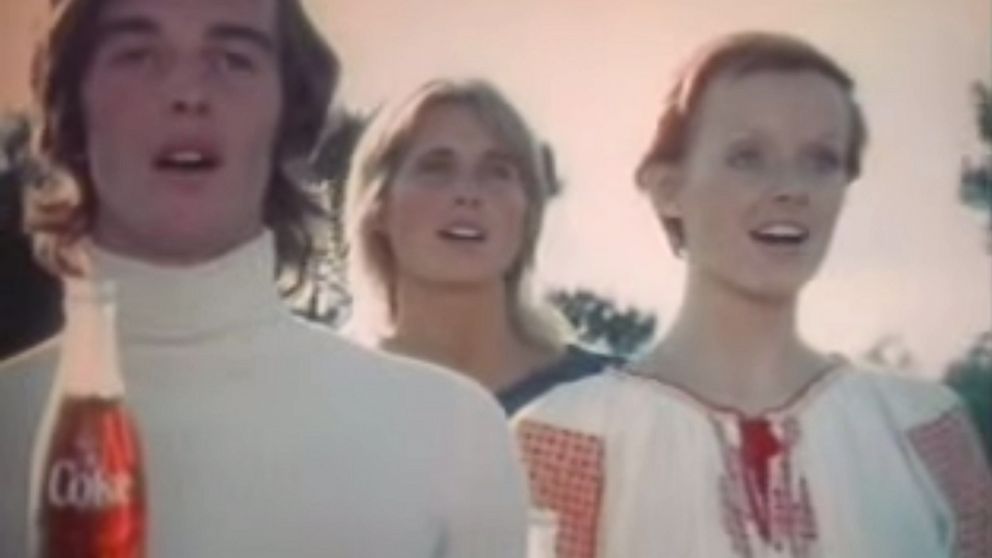
The acclaimed AMC series "Mad Men" completed its seven-season run Sunday, showing the famous 1971 Coca-Cola commercial, “I’d Like to Buy the World a Coke” in its closing moments.
The commercial’s use marks a notable departure for the show, because it blended fictitious characters and real-life ad success. The Coca-Cola commercial was developed by an actual ad man with McCann Erickson, the company that absorbs Draper’s agency in the final season of “Mad Men.”
Bill Backer -- like Draper, an ad whiz with an alliterative name -- served as creative director on the Coca-Cola account for McCann Erickson and is credited with developing the commercial’s concept. According to Coca-Cola, Backer was flying to London to write radio commercials. But because of heavy fog in London, his plane landed in Shannon, Ireland.
Some of the passengers -- who had to remain near the airport in case the fog lifted -- were furious about the situation. But the next day, Backer saw the passengers at the airport café and they were happy, enjoying conversation over snacks and bottles of Coca-Cola.
"In that moment, [I] saw a bottle of Coke in a whole new light. ... [I] began to see a bottle of Coca-Cola as more than a drink that refreshed a hundred million people a day in almost every corner of the globe,” he wrote later, according to Coca-Cola.
“That was the basic idea: to see Coke not as it was originally designed to be -- a liquid refresher -- but as a tiny bit of commonality between all peoples, a universally liked formula that would help to keep them company for a few minutes."
After arriving in London, Backer shared his idea of buying everyone in the world a Coke with the group employed for the radio commercials -- Billy Davis, music director on the Coca-Cola account, as well as British songwriters Roger Cook and Roger Greenaway. The group tinkered with the concept, and eventually music was added.
The New Seekers, a British-based pop group, recorded the jingle, “I’d Like to Buy the World a Coke.”
But what to do about the visual concept for the ad? According to Coca-Cola, art director Harvey Gabor came up with the idea for “The First United Chorus of the World,” a group of young people singing together on a hillside. Coca-Cola approved the concept, and filming commenced but was delayed because of rain.
The commercial -- dubbed the “Hilltop” ad -- was eventually recorded in Rome, but cost more than $250,000 because of the delays, according to Coca-Cola.
“I’d Like to Buy the World a Coke” was released in the United States in July 1971, becoming a classic advertising moment, reflecting 1970s optimism and social awareness. A version of the song, titled “I’d Like to Teach the World to Sing (in Perfect Harmony),” also became a radio hit for the New Seekers and a U.S.-based group, the Hillside Singers.
Backer discussed the commercial’s impact in a 2011 interview.
“It’s generally considered the world’s most popular commercial, and anybody’s proud to be associated with something this popular and ... I think, very good,” he said.
Backer, who co-founded the firm Backer and Spielvogel after leaving McCann Erickson in the late 1970s, was inducted into the Advertising Hall of Fame in 1995. The Coca-Cola commercial is one of Backer’s most notable pop culture contributions. He also helped to develop winning campaigns for Miller (“Tastes great/less filling”) and Campbell (“Soup is good food”), as well as Coke’s “It’s the Real Thing.”
Four decades after the “Hilltop” commercial first aired, its impact lingers -- a timeless message and earworm jingle that were already enmeshed in public consciousness, now also known for marking the close of one of the most significant shows in television history.