Alexander Acosta: Everything you need to know about Trump’s labor secretary nominee
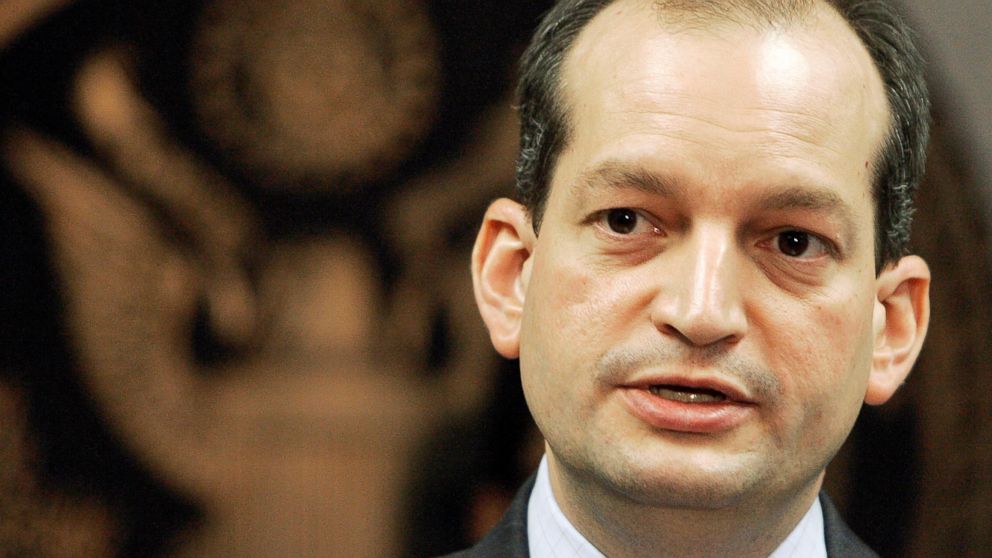
— -- U.S. Century Bank chairman Alexander Acosta, President Trump's nominee for labor secretary, will face the Senate committee on Health, Education, Labor and Pensions for his confirmation hearing today.
President Donald Trump tapped Acosta to be his pick for labor secretary back in February.
Acosta replaced Trump's first pick for labor secretary, fast food executive Andrew Puzder, who withdrew himself from consideration.
Aside from his work at Century Bank, Acosta has experience serving on the National Labor Relations Board and has an extensive background in law, including teaching employment law.
But he has courted controversy as well, overseeing a plea deal with financier and sex offender Jeffrey Epstein while he served as a U.S. attorney in Florida that was kept secret from Epstein's alleged victims. Trump, as well as former President Bill Clinton, spoke highly of Epstein before allegations surfaced in 2005.
“I've known Jeff for fifteen years," Trump said in a 2002 New York Magazine story. "Terrific guy.”
Here is everything you need to know about Acosta, Trump’s choice to lead the labor department:
Name: R. Alexander Acosta
Hometown: Miami, Florida
Education: Acosta has his bachelor’s degree and his law degree from Harvard.
What he does: Acosta currently serves as chairman of the board of U.S. Century Bank, the largest domestically owned Hispanic community bank in Florida, a post he took up in 2013. He is also the dean of the Florida International University (FIU) law school, a post he’s held since 2009.
What he used to do: Acosta formerly was a member of the National Labor Relations Board.
In 2003, President George W. Bush selected Acosta to serve as assistant attorney general for the DOJ’s civil rights division. Acosta made history as the first Hispanic man to hold the rank of assistant attorney general. The Miami native went on to serve as the U.S. attorney for Florida’s southern district.
Acosta started off his law career as a clerk for Justice Samuel Alito, when Alito was an appeals judge on the U.S. Court of Appeals for the Third Circuit. He then went on to practice law in Washington D.C. at the Kirkland & Ellis, specializing in employment and labor issues.
He also taught classes at George Mason University on employment law, disability-based discrimination law and civil rights law.
What you might not know about him: If confirmed, Acosta would be the first Hispanic member to serve in Trump's Cabinet.
About his Senate testimony for American Muslim civil rights
As dean of FIU Law, Acosta testified in front of a Senate judiciary subcommittee on March 29, 2011, arguing for the protection of the American Muslims’ civil rights in a post-9/11 America.
Acosta read to the Senate subcommittee members two accounts of American Muslims - the first of his FIU law student that enlisted in the U.S. military after the 9/11 attacks.
The second account was of a young girl who after 9/11 was suspended from school because she would not remove her hijab.
“[School officials] could have taken this opportunity to say that fear is wrong, that respect and tolerance for another’s faith is right, and that these are founding principles of our nation,” Acosta said at the time. “Instead, the school officials fed the fear, signaling to Nashala’s fellow sixth-graders that the headscarf, and by extension that her faith, should be suppressed.”
Acosta went on to praise the actions of the Justice Department in the wake of the 9/11 attacks and President George W. Bush’s visit to the Islamic Center of Washington D.C. on Sept. 17, 2001.
“These efforts following 9/11 were important. They set a tone. They reminded those who might be tempted to take out their anger on an entire community that such actions were wrong,” Acosta said.
His controversial deal with Jeffrey Epstein
While serving as the U.S. Attorney for Florida’s southern district, Acosta’s office cut a deal with Epstein, a wealthy financier who was being investigated by the FBI for allegations that he had engaged in sexual misconduct with up to dozens of underage girls.
The 2008 agreement -- called a secretive “sweetheart deal” by the lawyers for two of the alleged underage victims -- effectively immunized Epstein from federal prosecution in exchange for his guilty plea in state court and a light jail sentence.
Epstein pleaded guilty in 2008 to one count of solicitation of a prostitute and one count of solicitation of a prostitute who is a minor. He spent 13 months in a private wing of the Palm Beach county jail and was released in 2009. Epstein is registered as a level three sex offender.
The Epstein deal, which Acosta oversaw and approved, remains the subject of an ongoing victims-rights lawsuit in federal court filed in 2008 against the federal government. Acosta is not named as a defendant in the lawsuit.
The judge overseeing the case ruled that Acosta’s office had the legal obligation to inform the victims of the agreement with Epstein, but there has been no resolution on the question of whether the deal should be invalidated, as the victims seek.
In a 2011 letter, Acosta defended the deal and accused Epstein’s defense lawyers of a “a year-long assault on the prosecution and the prosecutors.”
Acosta argued that while critics think the prosecution should have been tougher, and "evidence that has come to light since 2007 may encourage that view," if more evidence was available to them at the time perhaps "the outcome may have been different.”
“Our judgment in this case, based on the evidence known at the time, was that it was better to have a billionaire serve time in jail, register as a sex offender and pay his victims restitution than risk a trial with a reduced likelihood of success,” Acosta wrote.