Anti-monarchists to protest King Charles III's coronation despite controversial new law

LONDON -- Anti-monarchists are expected to stage large-scale protests in London on Saturday during the coronation of Britain's King Charles III, despite warnings from authorities and a controversial new law.
Charles and his wife, Queen Consort Camilla, will be coronated side-by-side at Westminster Abbey. The new sovereign and consort will travel from Buckingham Palace to Westminster Abbey in the diamond jubilee state coach as part of the "king's procession" before returning to the palace in the gold state coach after their crowning as part of the "coronation procession." London's Metropolitan Police Service said it will have more than 11,500 officers on duty that day, making it "one of the most significant and largest security operations" that the agency has led.
"Our tolerance for any disruption, whether through protest or otherwise, will be low," the police force said in a statement on Wednesday. "We will deal robustly with anyone intent on undermining this celebration."

More than a thousand people will be protesting in Trafalgar Square as the royal processions pass by, according to Republic, a London-based campaign group advocating to replace the British monarchy with an elected head of state.
"We have had two meetings with the Met police and numerous phone conversations. They have repeatedly said they have no concerns about Republic's plans," the group's CEO, Graham Smith, said in a statement on Wednesday. "It is a mystery why the Home Office thought it was necessary to send us an anonymous letter that could be interpreted as intimidation."
Republic shared a link on its website to the letter in question, which was dated April 27. In the letter, the U.K. Home Office's Police Powers Unit details new criminal offenses that will be rushed into law to prevent disruption.

"I would be grateful if you could publicise and forward this letter to your members who are likely to be affected by these legislative changes," the letter stated, in part.
The changes are part of the so-called Public Order Bill, which came into effect on Wednesday after passing through U.K. Parliament and receiving royal assent from Charles. Under the new law, protesters who interfere with "key national infrastructure," such as blocking roads and railways, could face 12 months behind bars, an unlimited fine or both; anyone "locking on" or physically attaching themselves to other people, objects or buildings to cause "serious disruption" could face 6 months behind bars, an unlimited fine or both; and police will be empowered to stop and search protesters suspected of having intent to commit an offense.

United Nations High Commissioner for Human Rights Volker Turk has urged the U.K. government to reverse the "deeply troubling" legislation.
“This new law imposes serious and undue restrictions on these rights that are neither necessary nor proportionate to achieve a legitimate purpose as defined under international law," Turk said in a statement on April 27. "This law is wholly unnecessary as U.K. police already have the powers to act against violent and disruptive demonstrations."
Republic, however, "will not be deterred" and will protest in Trafalgar Square and along the procession route on Saturday as planned, according to Smith. Protesters will likely be holding yellow placards with the words "Not My King," as they have done at previous demonstrations organized by Republic.
"It is telling that Charles, who has had no problem speaking up on various issues, has chosen not to defend democratic rights when they are being threatened in his name," Smith added. "Perhaps he might make it clear that he believes in the right to protest."
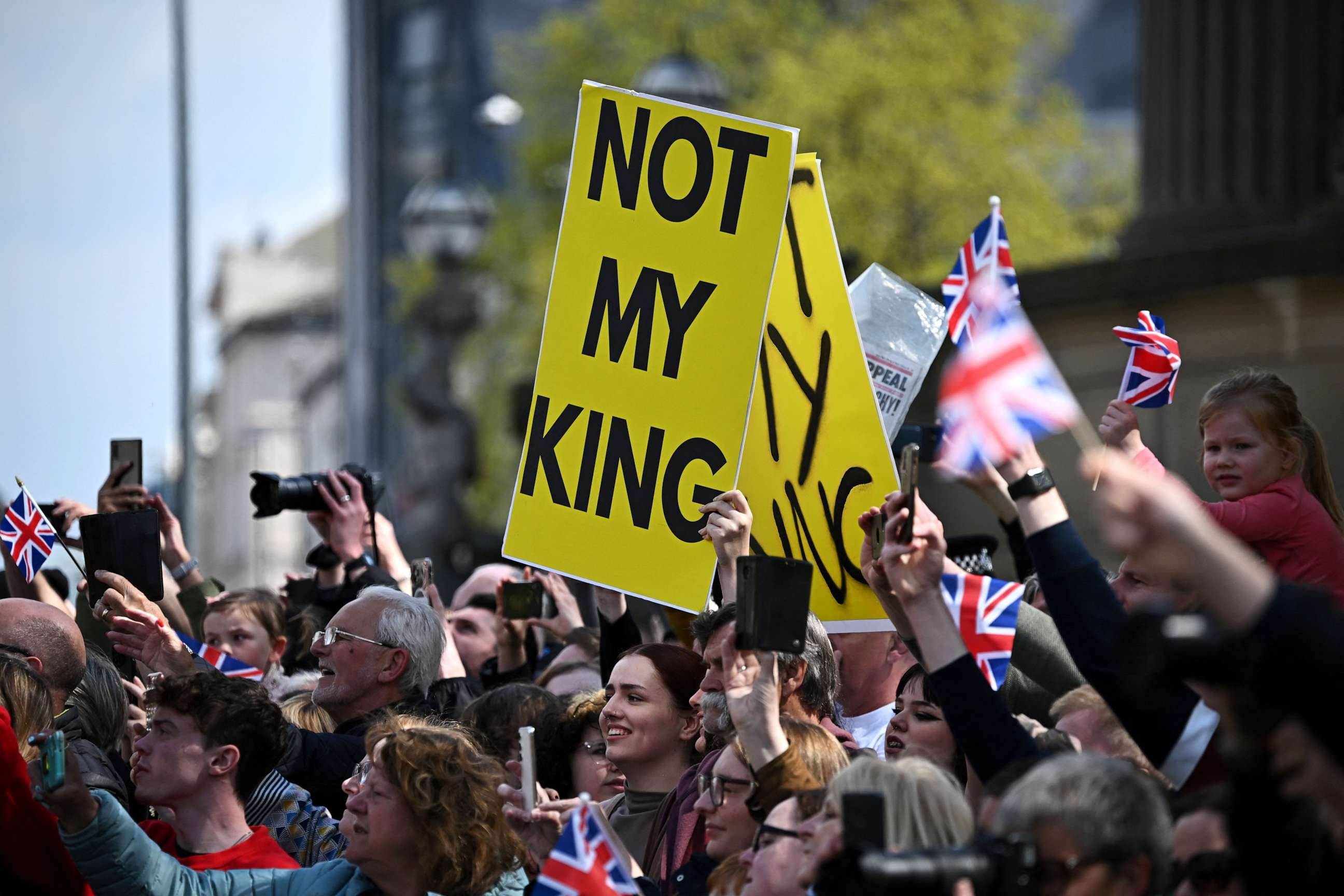
The anti-monarchy protest movement has gained fresh momentum in Britain since Queen Elizabeth II's death and Charles' ascension. Republic has garnered more support, both financially and in recruits to its cause, according to Smith.
"Charles has not inherited the respect and deference and sycophancy that the queen enjoyed," Smith told ABC News during an interview in March. "And it's a very different environment in which to campaign now."
A new survey conducted by London-based polling company YouGov found that overall support for retaining the British monarchy remains relatively high -- at 62% as of April. But that figure is significantly down from previous levels -- YouGov tracker data found backing for the crown as high as 75% in 2012 and 2013.
Moreover, the latest survey shows the younger generation is losing interest, with only 36% of 18- to 24-year-old Britons saying they want to keep the monarchy as of April. That's compared to 2013 when as many as 72% of 18- to 24-year-olds wanted to keep the institution, according to YouGov.
ABC News' Guy Davies and Zoe Magee contributed to this report.