Brightest Ever Supernova Observed Outshines Previous Record for Exploding Star
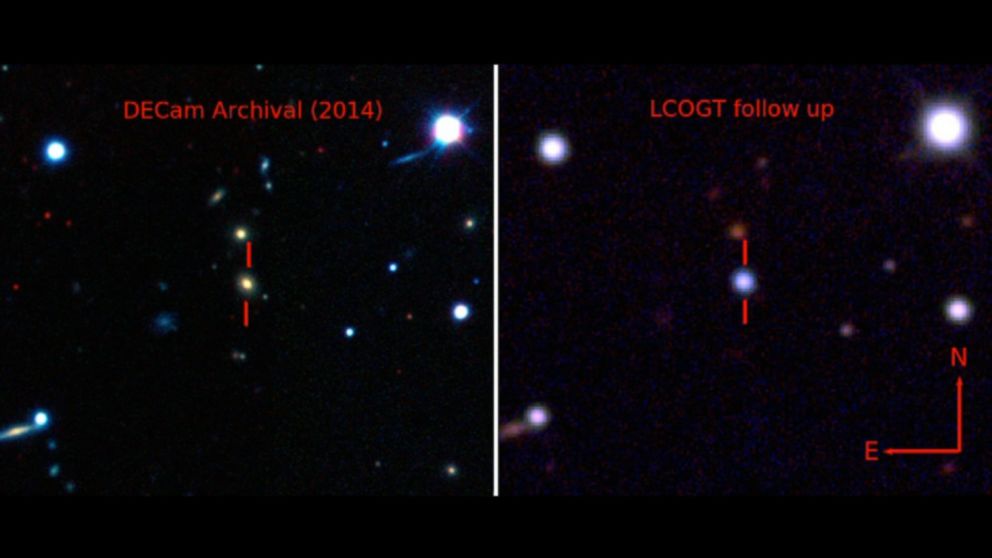
— -- Astronomers say they've discovered a superluminous supernova -- a cosmic explosion so bright it outshines the entirety of the Milky Way's 100 billion stars.
A supernova is an exploding star that shines with incredible luminosity -- marking the end of a star's life. While the celestial event is relatively common, what makes this particular discovery so special and perplexing to scientists is its luminosity. It's twice as bright as the previous record-holding supernova.
Named ASASSN-15lh and spotted by the Automated Survey for Supernovae, the supernova is believed to be 3.8 billion light years from Earth, according to an article published in the journal "Science." At its peak, scientists said the supernova may have been 570 billion times more luminous than our sun.
What caused the superluminous supernova, however, is a mystery scientists hope to unravel.
"ASASSN-15lh is the most powerful supernova discovered in human history," Subo Dong, an astronomer at Peking University and the paper's lead researcher, said in a statement. "The explosion's mechanism and power source remain shrouded in mystery because all known theories meet serious challenges in explaining the immense amount of energy ASASSN-15lh has radiated."
One possibility is the superluminous supernovae's energy comes from magnetars, which are highly magnetized, rapidly spinning neutron stars. Magnetars are the leftover, hyper-compressed cores of massive, exploded stars, according to scientists, who say that although it's a hypothesis, even that falls short of explaining the luminosity of ASASSN-15lh.
Next up: Researchers said they have been granted time this year on the Hubble Space Telescope, which will help give them even better views of the supernova -- and hopefully new insights into where it gets its power.