New Horizons Sends Back Stunning Image of Pluto's Moon Charon
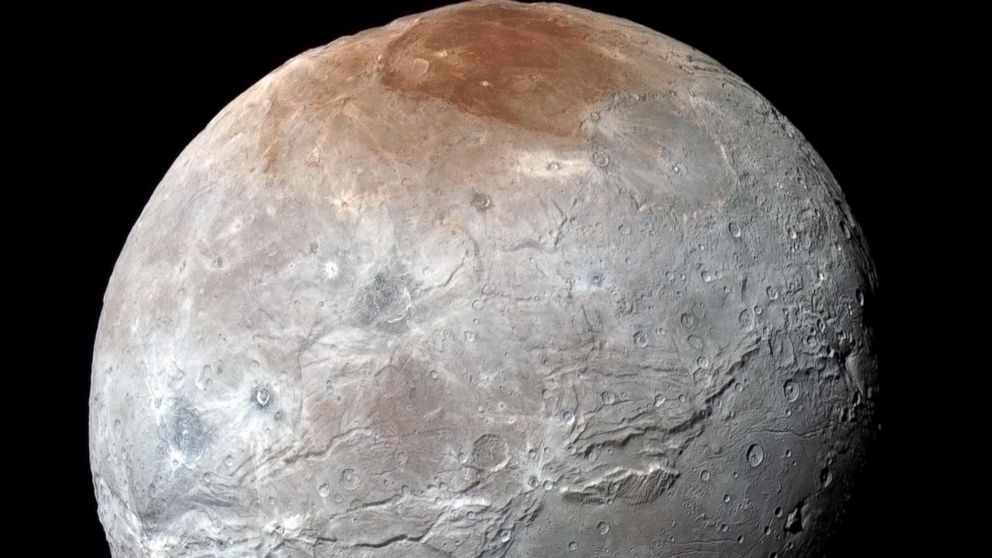
— -- The cracks, bruises and colorful spots on Pluto's largest moon, Charon, are captured in stunning new detail in photos sent back to Earth by NASA's New Horizons probe.
The high-resolution images of Charon show the complex terrain covered in mountains and craters. A canyon system stretching 1,000 miles across the face of Charon is four times as long as the Grand Canyon and twice as deep in places, indicating a violent tectonic history.
"We thought the probability of seeing such interesting features on this satellite of a world at the far edge of our solar system was low," Ross Beyer, an affiliate of the New Horizons Geology, Geophysics and Imaging team said in a statement, adding the team "couldn't be more delighted with what we see."
Plains south of the canyon are noticeably younger than the large cratered regions to the north, indicating signs of wide-scale resurfacing on Charon, according to NASA researchers.
The photos are the latest to be released as New Horizons continues to send a trove of data and photos from its July 14 flyby back to Earth. With data downlinking at a rate of about 1 to 4 kilobits per second, it's expected the entire trove of science will take one year to be transmitted back to Earth.
Launched in January 2006 on a 3-billion-mile journey to Pluto, New Horizons "phoned home" after its Pluto flyby, indicating that it had successfully navigated just 7,700 miles from the dwarf planet. It later sent back the first high-resolution images of Pluto's surface.
New Horizons conserved energy by taking "naps" during the monumental trip. The spacecraft, equipped with a battery that converts radiation from decaying plutonium into electricity, may have enough power for two more decades of exploration, according to NASA.
The piano-sized probe is speeding through the Kuiper Belt, an area at the edge of the solar system encompassing Pluto and a vast area of tiny, icy worlds. After the intensive data transmission process, NASA is considering another flyby of a Kuiper belt object known as 2014 MU69 that orbits nearly a billion miles beyond Pluto.
New Horizons loses about a few watts of power each year, according to NASA, but is estimated to have as much as 20 years left in its life expectancy.