New Horizons: A Look At Its 9-Year Path to Pluto
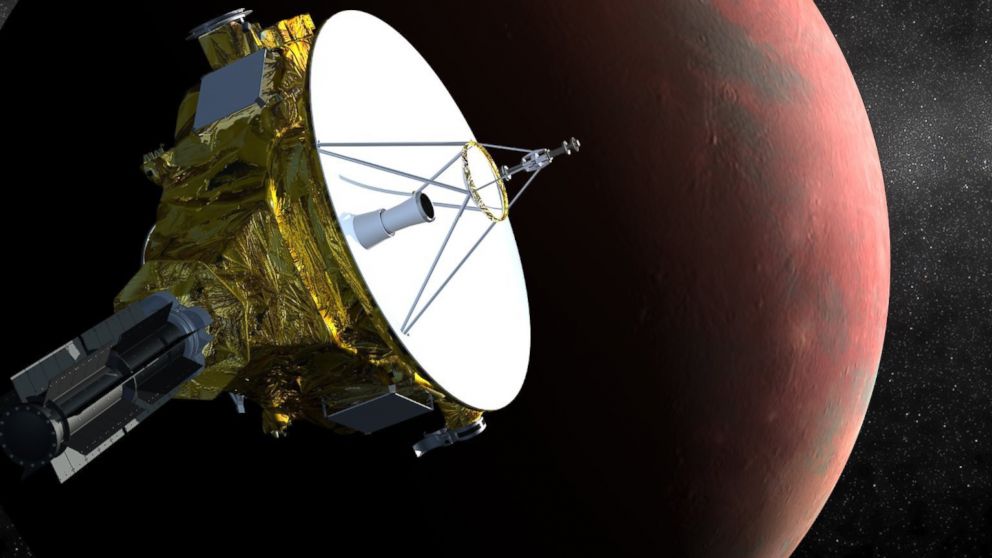
— -- Nine years and three billion miles after NASA's New Horizons probe blasted off on a mission to Pluto, the space probe is just one day away from its historic encounter with the dwarf planet.
NASA said today that the probe is one million miles from the icy dwarf planet, which has long remained a curiosity to scientists. If all goes according to plan, New Horizons will zoom past Pluto at 7:49 am EDT on Tuesday. The space probe will be traveling 30,800 and won't stop as it whizzes past Pluto.
Seven science tools on board the probe will be gathering data to send back to Earth, giving mankind the closest examination yet of the dwarf planet that sits on the edge of the solar system.
When New Horizons makes its closest approach to Pluto, the probe is expected to snap new images providing scientists with more clues about Pluto's terrain, however the spacecraft will also be gathering information on Pluto's Texas-sized moon, Charon, and its smaller moons Styx, Nix, Kerberos and Hydra.
Here's a look back at the nearly decade-long journey leading up to Tuesday's historic flyby:
New Horizons Launches
New Horizons blasted off for its long haul mission on Jan. 19, 2006, atop an Atlas V rocket, back when Pluto still enjoyed status as a planet. Scientists later that year voted to demote Pluto to a "dwarf planet."
During its epic trip, New Horizons has spent two-thirds of the time sleeping, taking a total of 18 naps, which helps NASA preserve the systems on board.

Jupiter Encounter
On its way to Pluto, New Horizons took a moment to snap some spectacular photos when it zoomed past Jupiter on February 28, 2007. While New Horizons was the eighth probe to visit the gas giant, it managed to gather new information about the planet, including lightning on its poles and boulder-size clumps moving through Jupiter's faint rings, according to NASA.
New Horizons Wakes Up
The spacecraft came out of hibernation in Decembe 2014 after being prompted by a computer command that was pre-programmed last August. About 90 minutes after New Horizons woke up, it began transmitting back to Earth.
Traveling from the outer reaches of the solar system, a radio signal moving at the speed of light took an astounding 4 hours and 26 minutes to reach NASA's Deep Space Network station in Canberra, Australia. With the receipt of that signal, it was clear New Horizons was ready for the home stretch of its mission.

Discoveries
Where do we begin? In February, the spacecraft took two long-exposure images showing two of Pluto's moons, Hydra and Nix, orbiting the dwarf planet. It was the first time the space probe had gotten close enough to view the moons. It's also gotten the closest ever look at Pluto's surface, spotting a heart-shaped feature on the icy dwarf planet.
New Horizons has also photographed other curious regions on Pluto, including an area NASA calls the "whale" and a bright donut-shaped area. It is believed the donut could be an impact crater or a volcano, however, researchers are holding off making any actual assessments until New Horizons gets a closer look.
Glitch
New Horizons had a scare earlier this month when it briefly entered safe mode. NASA said the glitch appeared to be caused by a "hard-to-detect timing flaw in the spacecraft command sequence" and that the probe was later running normally and ready for its big day on Tuesday.