Engineers Developing Tick-Killing Robot
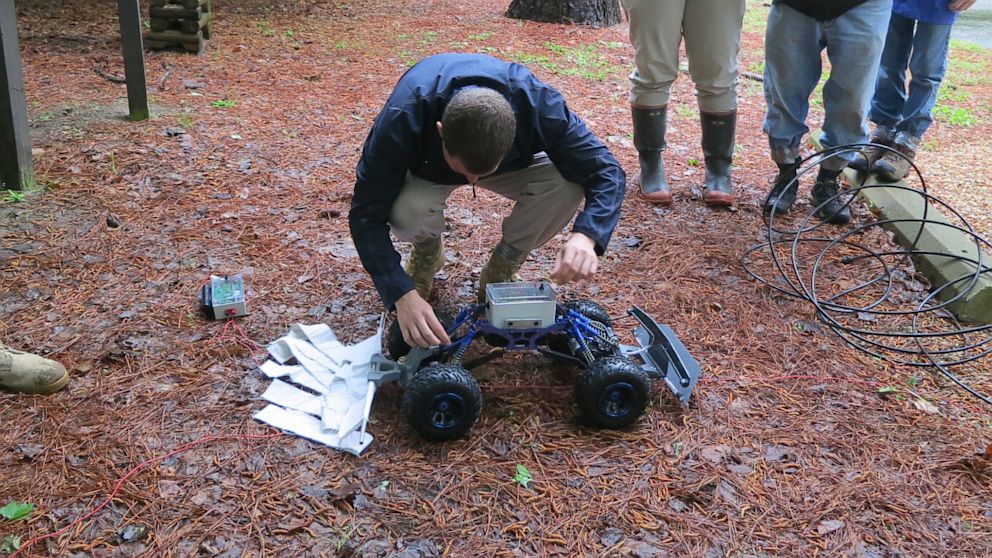
Jul. 17, 2013 — -- Virginia Military Institute engineers may soon be rolling out an especially lethal weapon in the war against ticks.
A team of professors is testing the "tick rover," a robot that they claim has had remarkable success reducing the blood-suckers' populations in test runs.
Dr. James Squire, project lead and professor of electrical engineering at VMI, told ABC News he was inspired to create a tick-fighting robot after discovering the bugs on his toddler son years ago.
"We did it [a test] in an area that was so overrun with lone star ticks that the local school board forbade the school from taking school trips there because the students were picking up so many ticks," Squire, said. "In every case there is 75 percent, 90 percent, 100 percent removal," he added.
Bio-mimicry, the capacity of the robot to emulate a live host, is at the heart of the removal process. "They [ticks] can sense minute amounts of carbon dioxide, they can sense vibration 50 feet away," said Squire.
To mimic a live host, a tube is laid down in a yard to exude carbon dioxide, which draws the ticks to one side of the tube. Thirty minutes later, the Tick Rover is sent by the tube dragging a cloth treated with pesticide. The ticks, sensing a potential host, latch on to and climb up the cloth in search of a blood meal but instead absorb the deadly pesticide and die hours later.
"It's got carbon dioxide. It's something moving. It's something that is very easy to cling to. And those are the kinds of behaviors we exploited, basically... successfully," David Livingston of VMI told ABC News affiliate WSET.
"The cool part about this is that it leaves no pesticide in the environment," Squire added.
Squire says that it further tests prove successful, he plans on commercializing the tick rover on a franchise basis to pest-control businesses.
Ticks are responsible for transmitting a variety of infectious diseases that may prove deadly or debilitating. In June a 6-year-old girl from North Carolina died after being bitten by a tick and contracting Rocky Mountain Spotted Fever, and in March, a Connecticut jury awarded $47 million to a girl who was left brain damaged after contracting encephalitis from a tick bite in China.
To protect yourself against ticks, wear clothing that covers, use tick repellant and inspect yourself and your companions for ticks after spending time in wooded or grassy areas and remove them as fast as possible.