Firefighters say they've never seen anything like Spain's record blaze
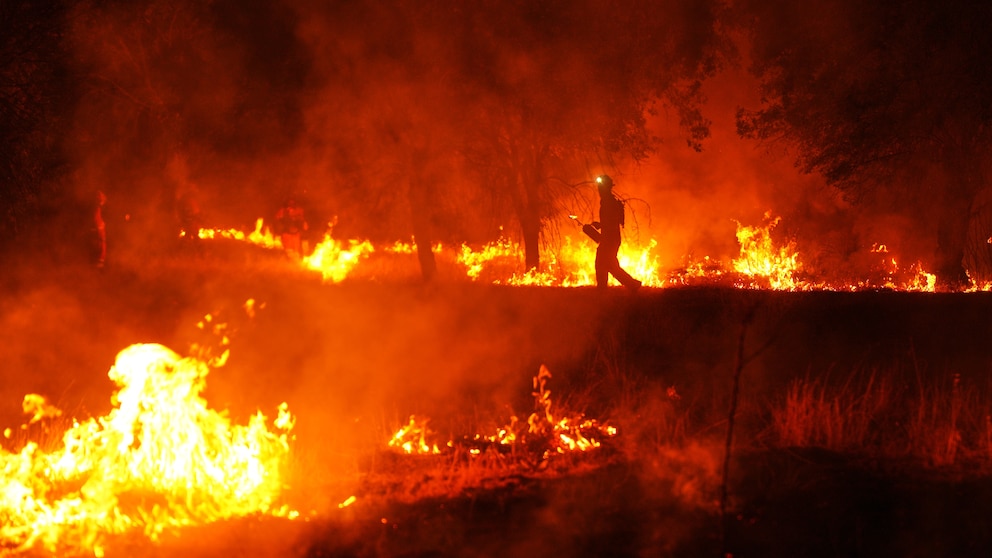
BARCELONA, Spain -- Spanish firefighter Javier García has never faced anything like the record blaze raging near Madrid in his two decades protecting woodlands and rural communities.
“This doesn’t have a precedent,” García told The Associated Press by phone before another long day ahead.
The out-of-control fire has consumed 500 square kilometers (193 square miles) — an area five times the size of Barcelona — and forced 25,000 people to flee villages in the smoldering hills of Ávila west of Madrid, the capital.
The ferocity of Spain’s largest recorded wildfire is forcing firefighters to fundamentally change their tactics, prioritizing evacuations and property protection due to the danger posed by fast-moving walls of flames and blazes too powerful to attack directly.
“The evolution is alarming,” García said.
Before, his brigade would tackle fires in the wilderness. Now they are a last line of defense, focused on saving lives. No deaths from these fires have been reported, while 79,000 people have fled their homes from the Ávila fire, another fire nearby in the Madrid region and one in eastern Castellón.
“That gives us more work and more stress,” García said. “Now it is lives first, then homes, and after, the forest."
García works with one of Spain’s emergency wildfire brigades, which deploy to help regional firefighters when they need help. They spend 12-hour shifts hosing down burning trees and hacking away at underbrush before it becomes fuel for the flames.
His 40-man unit, based in Ávila, has been working for three days on the Ávila fire. Before that, they fought fires in Guadalajara and near Zaragoza in recent weeks. The Guadalajara fire consumed 320 square kilometers (123 square miles), making it Spain's third largest on record.
“Until last year, I had never experienced fighting one big fire after another,” the 43-year-old García said.
Large areas of Spain have always been fire-prone thanks to its hot summers and relatively dry climate. But experts and government officials say that climate change has increased the frequency of heat waves and periods of drought, extending periods of high risk for wildfires.
Once one ignites, it grows at a speed and voracity rarely seen before.
García said there used to be around 15 days of extreme fire risk each year. Now firefighters are on alert for 30 to 40 days.
Fires have burned 1,530 square kilometers (590 square miles) this year in Spain — six times the area scorched by blazes in the first half of 2025, Sara Aagesen, the ecology minister, has said.
Meanwhile, a monster fire in neighboring France has forced over 200,000 people to flee their homes.
Raúl Guerrero, 29, has worked as a firefighter in Castilla y León, the region including Ávila, for the past decade. He said this fire can't compare with any he has battled.
He told the AP that his 40-man unit has had to retreat to safer ground on several occasions when the danger of being trapped was imminent.
He said the fire at several moments was “beyond the capacity of extinction,” which, he said, means “the fire is so virulent and has such power that no matter what you do, you can’t put it out.”
Asked how that makes him feel, Guerrero said “above all, impotent.”
While fires are often started by lighting or a spark made by agricultural machinery, a decisive factor that makes wildfires harder to combat is the disappearance of the farms, orchards and local forestry industries that used to create buffer areas around villages and towns.
Vegetation now grows right up to homes, Guerrero said. He called for property owners and local authorities to work all year in clearing brush away from homes and tending to forests.
If not, Guerrero said, that vegetation will remain “pure gunpowder” for future fires.