Fossils found in North America reveal new species of 'very odd' sea monster: Scientists

A prehistoric sea monster never-before-known to man was hunting prey in North America 85 million years ago, fossils found decades ago in Canada reveal.
The first set of fossils, found in 1988 along the Puntledge River on Vancouver Island, were determined to belong to elasmosaurs, a genus of plesiosaur that lived in North America during the Late Cretaceous period, about 80.6 to 77 million years ago, according to the paper, published in the Journal of Systematic Palaeontology. Additional fossils found since include an isolated right humerus and a well-preserved juvenile skeleton comprising of a thorax, girdles and limbs, according to the study.
But they have now been formally identified to belong to a "very odd" new genus of sea monster called Traskasaura sandrae, the researchers said.
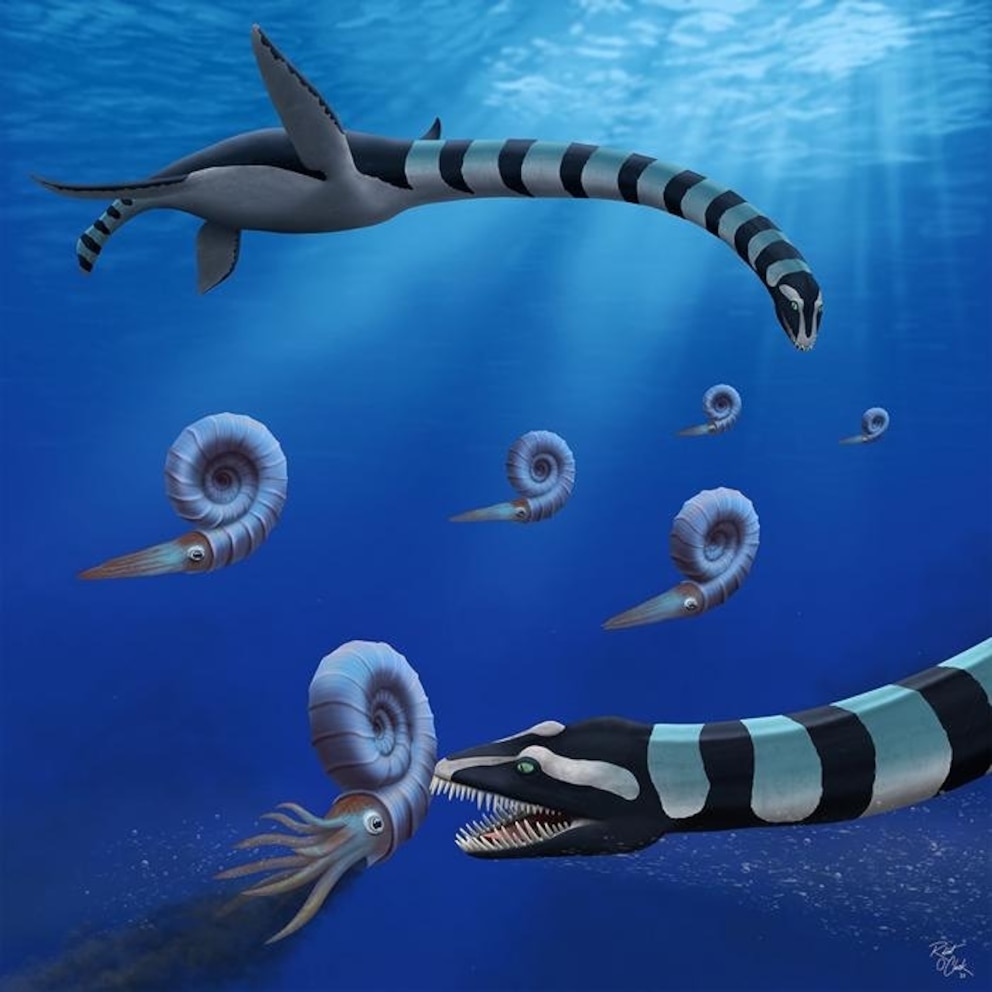
The long-necked creature likely measured about 39 feet and had heavy, sharp teeth that were "ideal for crushing" ammonite shells, according to paleontologists. Dozens of well-preserved cervical vertebrae indicate at least 50 bones in the neck -- likely more, the researchers said.
T. sandrae also had a "strange mix" of primitive and derived traits, unlike any other elasmosaur. Its unique adaptations allowed it to hunt prey from above -- the first of the plesiosaur taxa to do so, the paper states.
Prey was likely abundant in the region at the time, the scientists said.
"It has a very odd mix of primitive and derived traits," O'Keefe said. "The shoulder, in particular, is unlike any other plesiosaur I have ever seen, and I have seen a few."
When lead author F. Robin O’Keefe first saw the fossils and realized they belonged to an entirely new taxon, he hypothesized that they may be related to the plesiosaurs from Antarctica, he said in a statement. But it is "a strange, convergently evolved, fascinating beast," O'Keefe said.
"The fossil record is full of surprises," O'Keefe said. "It is always gratifying to discover something unexpected."
The fossils are among the most famous in the country. In 2002, they were adopted by the Province of British Columbia and declared the official fossil emblem of British Columbia.
"Plesiosaur fossils have been known for decades in British Columbia," O'Keefe said. "However, the identity of the animal that left the fossils has remained a mystery, even as it were declared BC’s provincial fossil in 2023. Our new research, published today, finally solves this mystery."
Paleontologists were reluctant at first to erect a new genus based solely on the adult skeleton of the elasmosaur. But a new “excellently preserved” partial skeleton enabled this latest international team of scientists from Canada, Chile and the U.S. to eventually identify the new genus and species.
The genus name Traskasaura was given in honor of Courtenay, British Columbia, where the researchers who discovered the original specimen in 1988 were based. The species name sandrae honors Sandra Lee O’Keefe, a member of the team of researchers who identified the fossils in 2002.
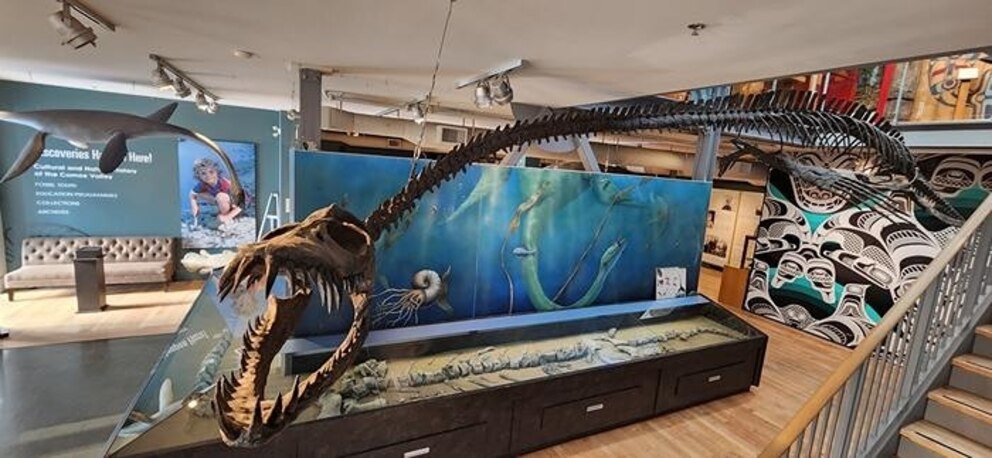
They are currently on display at the Courtenay and District Museum and Palaeontology Centre in Courtenay, British Columbia.