• Video
  • Shop
  • Culture
  • Family
  • Wellness
  • Food
  • Living
  • Style
  • Travel
  • News
  • Book Club
  • Newsletter
  • Privacy Policy
  • Your US State Privacy Rights
  • Children's Online Privacy Policy
  • Interest-Based Ads
  • Terms of Use
  • Do Not Sell My Info
  • Contact Us
  • Recalls and Product Safety Alerts
  • © 2026 ABC News
  • News

Largest coral bleaching event on record impacts 84% of world's reefs: NOAA

1:14
Mission UNESCO - 1 OCEAN
Thermoresistant 'super corals' offer hope amid climate change: Scientists
Napat Wesshasartar/Reuters, FILE
ByLeah Sarnoff
April 23, 2025, 9:04 PM

The world's coral reefs are in the midst of the fourth and largest global bleaching event in recorded history, the National Oceanic and Atmospheric Administration announced this week.

The grim milestone was recorded between January 2023 and April 2025, with the agency documenting that bleaching-level heat stress has impacted 83.7% of the world's coral reef area.

The impacted reefs span at least 83 countries and territories, the agency said.
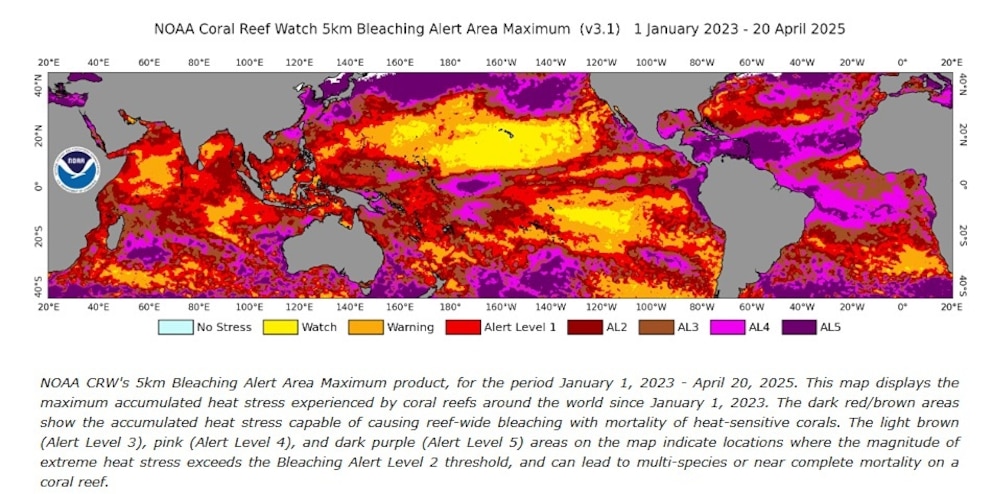
PHOTO: coral reef bleaching map
NOAA

Related Articles

MORE: 4th global coral reef bleaching event underway as oceans continue to warm: NOAA

Since early 2023, mass bleaching of coral reefs has been confirmed in the Atlantic, Pacific and Indian ocean basins, including parts of Florida and the coastline of the United States, the Caribbean, Central America, South America, Australia, the South Pacific, the Persian Gulf, coasts of East Africa and Indonesia, according to NOAA.

The agency deemed this ongoing bleaching event "the biggest to date," noting that the previous record was set with 68.2% of reefs affected during the third-largest bleaching period, between 2014 and 2017.

The first and second global coral bleaching events occurred in 1998 and 2010, respectively, according to the agency.
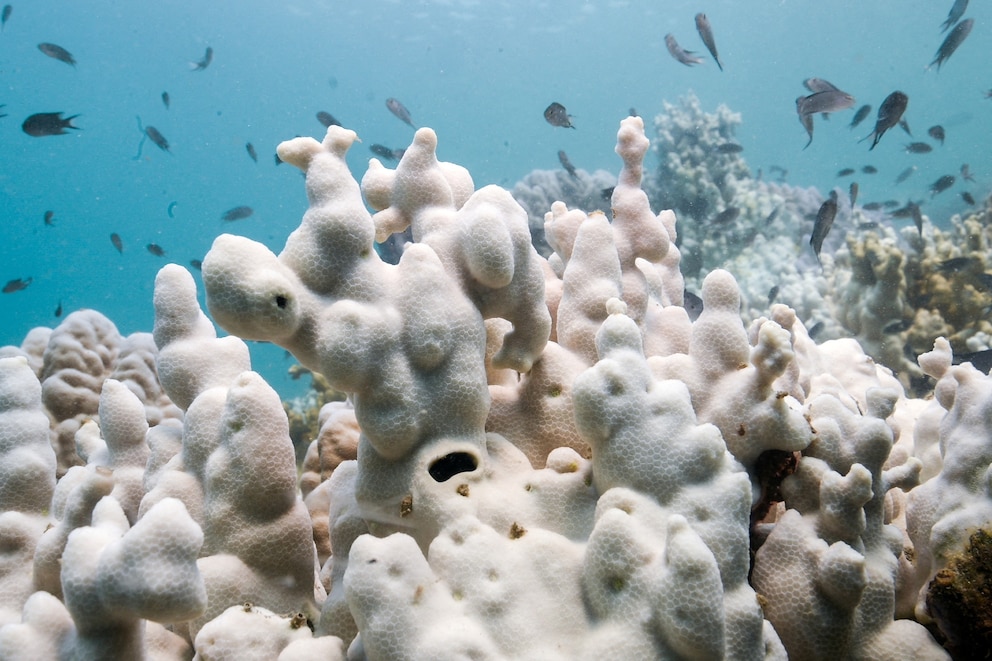
In this May 8, 2024, file photo, bleached corals are seen in a reef in Koh Mak, Trat province, Thailand.
Napat Wesshasartar/Reuters, FILE

Related Articles

MORE: Thermoresistant 'super corals' offer hope amid climate change: Scientists

Bleaching occurs when warmer ocean temperatures cause the expulsion of algae that live in the coral tissue. This leaves the coral completely white, known as coral bleaching. Coral bleaching does not necessarily mean corals will die, according to NOAA, which noted that corals can recuperate if the strain on their ecosystems is reduced.

At a local level, storms, disease, sediments and changes in salinity can cause corals to bleach; however, mass bleaching, when several varieties of coral reefs are bleached, is largely caused by increased sea temperatures, according to the Australian Institute of Marine Science.

Up Next in News—

French lawmakers adopt social media ban for kids under 15

July 21, 2026

Trial begins for mom accused of killing her 3 children

July 20, 2026

Officer speaks out after rescuing driver trapped in burning car

July 20, 2026

Taylor Farms recalls lettuce in 27 states amid cyclosporiasis outbreak: What to know

July 20, 2026

Shop GMA Favorites

ABC will receive a commission for purchases made through these links.

Sponsored Content by Taboola

The latest lifestyle and entertainment news and inspiration for how to live your best life - all from Good Morning America.
  • Contests
  • Terms of Use
  • Privacy Policy
  • Do Not Sell My Info
  • Children’s Online Privacy Policy
  • Advertise with us
  • Your US State Privacy Rights
  • Interest-Based Ads
  • About Nielsen Measurement
  • Press
  • Feedback
  • Shop FAQs
  • ABC News
  • ABC
  • All Videos
  • All Topics
  • Sitemap
  • Recalls and Product Safety Alerts

© 2026 ABC News
  • Privacy Policy— 
  • Your US State Privacy Rights— 
  • Children's Online Privacy Policy— 
  • Interest-Based Ads— 
  • Terms of Use— 
  • Do Not Sell My Info— 
  • Contact Us— 
  • Recalls and Product Safety Alerts— 

© 2026 ABC News