• Video
  • Shop
  • Culture
  • Family
  • Wellness
  • Food
  • Living
  • Style
  • Travel
  • News
  • Book Club
  • Newsletter
  • Privacy Policy
  • Your US State Privacy Rights
  • Children's Online Privacy Policy
  • Interest-Based Ads
  • Terms of Use
  • Do Not Sell My Info
  • Contact Us
  • © 2026 ABC News
  • News

Could our solar system have 9 planets after all? Astronomers may have confirmed possible existence.

2:43
Hints of life found on distant planet
Caltech/R. Hurt (IPAC)
ByJulia Jacobo
May 02, 2025, 5:06 PM

Our solar system may have a ninth planet after all, researchers say.

The possibility that an additional planet may be hidden far into the solar system was touted more than a century ago. But astronomers may have found new evidence that points to a celestial body that could be a possible candidate as "Planet Nine," according to a new paper, which has been accepted for publication in the Publications of the Astronomical Society of Australia but not yet peer-reviewed.

Related Articles

MORE: Exoplanet discovered in 2020 has the coldest temperatures ever measured, scientists say

The hidden candidate is likely the size of Neptune and is so far away that it could take between 10,000 and 20,000 years to orbit the sun, according to the paper.

Two deep infrared surveys taken 23 years apart measured the object's orbital motion. In 1983, the Infrared Astronomy Satellite surveyed the universe for a year. In 2006, the Japanese Aerospace Exploration Agency launched the infrared satellite AKARI, which was active until 2011.

Researchers at the University in Taiwan compared objects that were observed in the IRAS database with the data obtained by AKARI to see if there were any movements within that time frame.

PHOTO: Caltech professor Mike Brown and assistant professor Konstanin Batygin have been working together to investigate distant objects in our solar system for more than a year and a half.
Caltech professor Mike Brown and assistant professor Konstanin Batygin have been working together to investigate distant objects in our solar system for more than a year and a half. The two bring very different perspectives to the work: Brown is an observer, used to looking at the sky to try and anchor everything in the reality of what can be seen; Batygin is a theorist who considers how things might work from a physics standpoint.
Lance Hayashida/Caltech

The candidate for Planet Nine displayed a tiny amount of movement, which could mean it advanced further in its orbit around the sun.

Some of the strongest evidence that points to the existence of a planet within the outskirts of the solar system is the activity within the Kuiper Belt, an unusual clustering of icy bodies -- including comets and dwarf planets -- which stretches from Neptune and outward toward interstellar space.

Related Articles

MORE: Several planets found orbiting star less than 6 light-years away

Six known objects in the Kuiper Belt have elliptical orbits pointing in the same direction. In addition, objects from the Kuiper Belt orbit in the opposite direction from everything else in the solar system, according to NASA. This could be the result of a gravitational pull from a nearby planet, the researchers said.

Moreover, the object reflects just a faint amount of sunlight, furthering the likelihood that it is, indeed, a planet, according to the study.
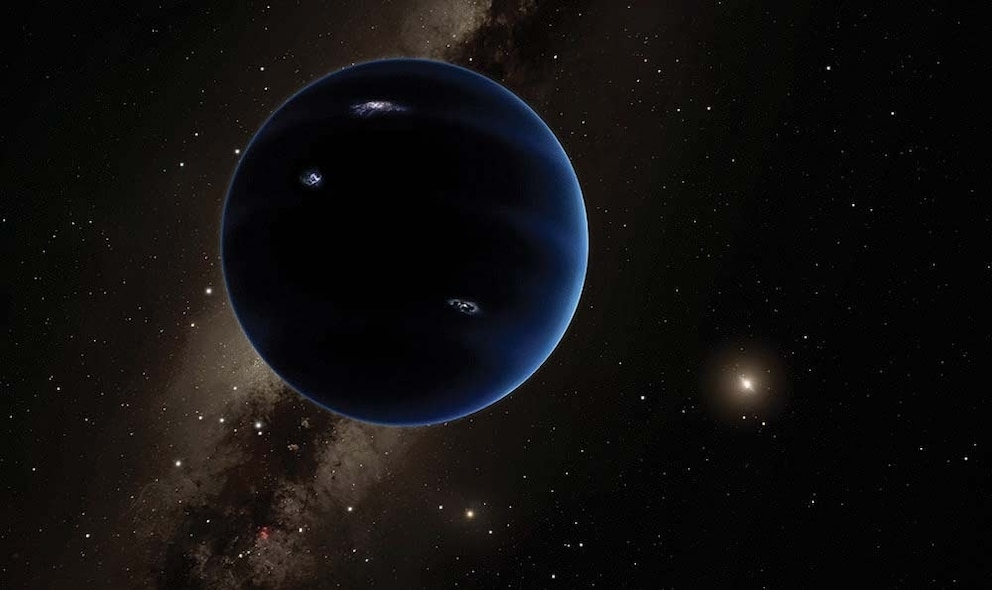
PHOTO: This is a distant view from Planet Nine back towards the sun.
This is a distant view from Planet Nine back towards the sun. The planet is thought to be gaseous, similar to Uranus and Neptune. Hypothetical lightning lights up the night side.
Caltech/R. Hurt (IPAC)

The International Astronomical Union downgraded Pluto's classification to a dwarf planet in 2006, mainly because other objects might cross its orbit. Pluto was previously considered to be the ninth planet in our solar system, but the new definition of a planet requires the celestial body to have enough gravity to clear its orbital path from other bodies.

Related Articles

MORE: Binary star system found near the Milky Way's black hole: An 'amazing' discovery, astrophysicists say

There are currently several lines of observational evidence pointing to the existence of Planet Nine, according to NASA.

The surveys did not provide enough data to determine the full orbit of the planetary candidate, meaning more observations will be needed, the researchers said.


Up Next in News—

Gas station clerk speaks out after foiling alleged kidnapping

April 15, 2026

Oklahoma high school principal takes down would-be shooter, hailed as hero

April 15, 2026

Family seeks answers after influencer Ashlee Jenae is found dead on vacation in Tanzania

April 15, 2026

Couple shares warning after nearly losing down payment in mortgage fraud

April 10, 2026

Shop GMA Favorites

ABC will receive a commission for purchases made through these links.

Sponsored Content by Taboola

The latest lifestyle and entertainment news and inspiration for how to live your best life - all from Good Morning America.
  • Contests
  • Terms of Use
  • Privacy Policy
  • Do Not Sell My Info
  • Children’s Online Privacy Policy
  • Advertise with us
  • Your US State Privacy Rights
  • Interest-Based Ads
  • About Nielsen Measurement
  • Press
  • Feedback
  • Shop FAQs
  • ABC News
  • ABC
  • All Videos
  • All Topics
  • Sitemap

© 2026 ABC News
  • Privacy Policy— 
  • Your US State Privacy Rights— 
  • Children's Online Privacy Policy— 
  • Interest-Based Ads— 
  • Terms of Use— 
  • Do Not Sell My Info— 
  • Contact Us— 

© 2026 ABC News