NASA Launches Telescope to the Sun
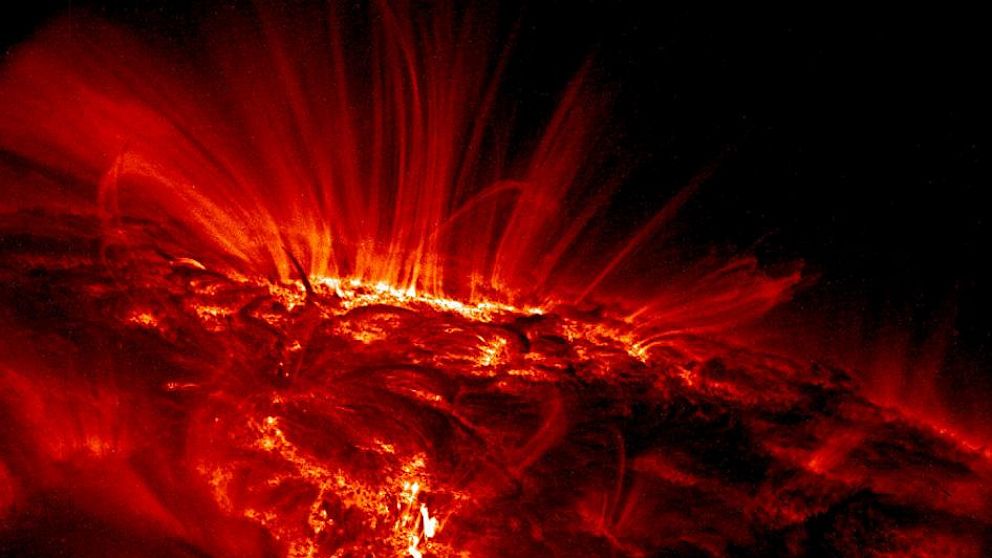
June 27, 2013— -- One of the few things you might have learned about the sun in elementary school and consequently remembered is that on the sun, hydrogen is built into helium at a temperature of millions of degrees. But one thing that you might not have learned is that it's not millions of degrees all over.
One of NASA's latest projects is to figure out how and why that is. Launched Thursday night, the Interface Region Imaging Spectrograph (IRIS) is equipped with a telescope that will take a picture of the sun every five seconds. Rather than just a standard photograph, the telescope's pictures will be able to filter what it sees based on temperature. It's been tailored to be used between 5,000 and 65,000 degrees Kelvin, although it can also take photos of solar flares that can reach up to 10 million K. Yes, it's really, really hot.
Unlike Earth, where areas in the same layer of the atmosphere are about the same temperature, the sun's temperature widely varies even within each layer of the heliosphere. Not only do large temperature differences exist, but large density differences exist too, with some regions of the heliosphere a million times more densely packed than others.
One of the main reasons for this uneven distribution of heat and mass is the constant turbulence swirling up and down between the various layers of the heliosphere. NASA wants IRIS to image these currents as precisely as it can. In addition to the telescope is a spectrograph that will scan the sun every second.
The graphs (or spectra) that it produces show how much of any specific wavelength of light is visible at a given point in time. When the spectra are used in conjunction with the telescope's images, NASA will be able to track solar material as it moves around and see when and where it picks up heat and energy.
The IRIS launched from the Vandenberg Air Force Base in California at around 10:20 p.m. ET.