Newly discovered comet likely an 'interstellar visitor,' NASA says
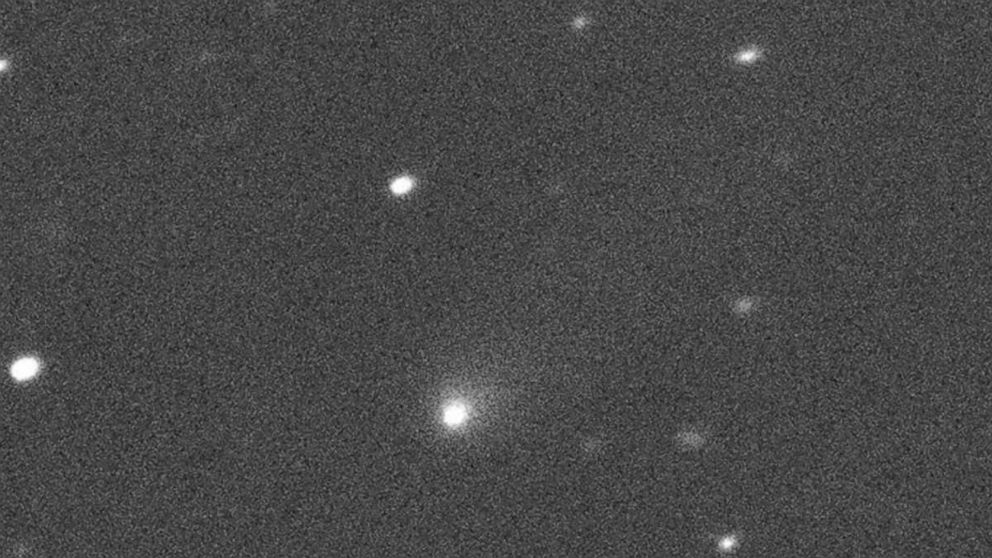

The discovery of a new comet scientists believe to be an "interstellar object" has set the astronomy community abuzz.
If officially confirmed, the object would be only the second of its kind detected, according to a statement from NASA's Jet Propulsion Laboratory at the California Institute of Technology.
The newly found comet, dubbed C/2019 Q4, was discovered by Gennady Borisov, a Crimean astronomer working out of an observatory in Nauchnij, Crimea.
Scientists believe the comet to be interstellar after studying its trajectory and velocity.
"The comet's current velocity is high, about 93,000 mph [150,000 kph], which is well above the typical velocities of objects orbiting the Sun at that distance," Davide Farnocchia, an astronomer at the Jet Propulsion Laboratory, said in a statement.
"The high velocity indicates not only that the object likely originated from outside our solar system, but also that it will leave and head back to interstellar space," he added.
The comet -- consisting of an icy body surrounded by a cloud of dust and particles -- is currently approaching the sun, but the closest it is projected to come towards Earth is about 190 million miles, according to the NASA statement.
It will be visible with professional telescopes in the coming months and "will peak in brightness in mid-December and continue to be observable with moderate-size telescopes until April 2020," according to Farnocchia.
The first known interstellar object to visit our solar system, the history-making asteroid named the 'Oumuamua, was discovered by astronomers in October 2017 and puzzled the scientific community at the time, even setting off since-debunked rumors of extraterrestrial activity.
'Oumuamua is a Hawaiian name for "a messenger from afar arriving first" and has been described by astronomer Paul Chodas of NASA's Jet Propulsion Laboratory as "a strange visitor from a faraway star system, shaped like nothing we’ve ever seen in our own solar system neighborhood."