The quiet release of the Pentagon's new policy on transgender service: Analysis
The Pentagon quietly released its new policy on transgender service on Wednesday, almost 600 days after President Donald Trump first announced he intended to ban transgender individuals from the military.
Trump's announcement by tweet in July 2017 kicked off a string of lawsuits against the administration that culminated with the Supreme Court's decision last month to allow the Pentagon to begin enforcing the new policy. Last week, a federal judge in Maryland lifted the last injunction against the ban, so the Trump administration notified the D.C. District Court that it intended to move forward.
On Wednesday morning, the Pentagon sent a copy of the policy directive to defense reporters, but it came without a statement of support from the White House, acting Defense Secretary Patrick Shanahan, or even the Pentagon's press office.
Some reporters, including from ABC News, were invited to dial into a 30-minute call with two defense officials, but the information was not attributable to anyone by name per the Pentagon.
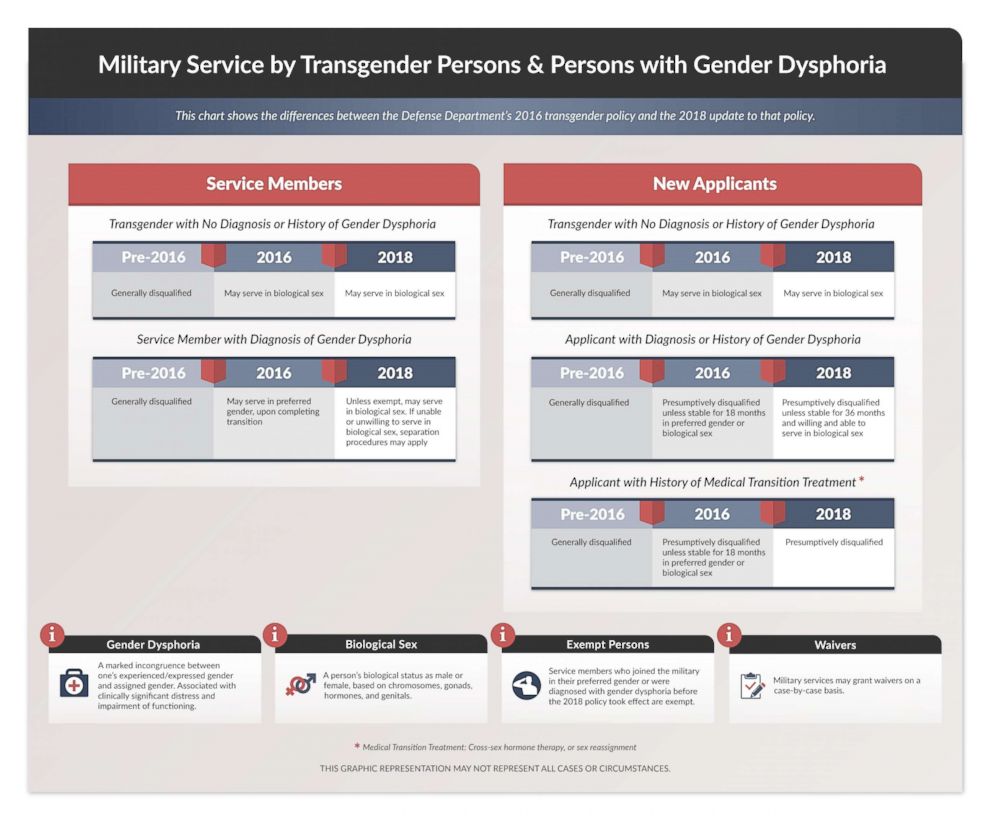
The unveiling of the new policy, which affects about 9,000 service members who self-identify as transgender, was in stark contrast to how the Obama administration released its policy in 2016 that allowed transgender individuals to serve openly.
In that rollout, then-Defense Secretary Ash Carter went before cameras, answering questions from reporters and explaining why it was the correct policy change. Carter said at the time that the military didn't want any barriers that would prevent the department "from recruiting or retaining the soldier, sailor, airman, or Marine who can best accomplish the mission."
But no such high-profile briefing accompanied Wednesday's rollout.
The Pentagon Briefing Room hasn't been used by a defense secretary since August of last year. The Pentagon's primary spokesperson has not briefed reporters on camera since May.
One of the only opportunities to hear from Pentagon officials about the new policy happened last month when the House Armed Services Military Personnel Subcommittee held a hearing with four active-duty transgender service members, along with James Stewart, performing the duties of under secretary of defense for personnel and readiness, and Vice Adm. Raquel Bono, director of the Defense Health Agency.
Stewart told the committee that the Trump administration's policy is not about transgender individuals, but those diagnosed with gender dysphoria specifically and that the policy put in place under the Obama administration would "degrade military readiness" in the long term.
But the four service chiefs of the Army, Navy, Air Force and Marine Corps have testified in Congress that the presence of transgender service members has had no effect on unit cohesion, discipline or morale -- a sentiment echoed by the active duty transgender service members last month.
Defense officials were asked by reporters on Wednesday for the data that shows transgender individuals have a negative effect on military readiness and unit cohesion, but officials conceded that it doesn't exist because the Defense Department doesn't track transgender service members. Instead, officials pointed to the panel of experts assembled by former Defense Secretary James Mattis who used their military and professional judgment to make policy recommendations.
Officials again said the policy was "not a ban on transgender individuals serving in the military" but focused on those diagnosed with gender dysphoria, defined as "a marked incongruence between one's experienced/expressed gender and assigned gender ... associated with clinically significant distress and impairment of functioning." The Pentagon argues the policy simply allows the department to deal with gender dysphoria as it would any other diagnosis or disorder that would impair someone's ability to serve.
Dr. Jesse M. Ehrenfeld, chair-elect of the American Medical Association Board of Trustees, testified before Congress last month that there was "no medically valid reason, including the diagnosis of gender dysphoria, to exclude transgender individuals from military service."
"This is the position of most major medical organizations," Ehrenfeld said.
The policy is available online here and takes effect April 12.