Russia calls Trump's national security strategy 'imperialist'
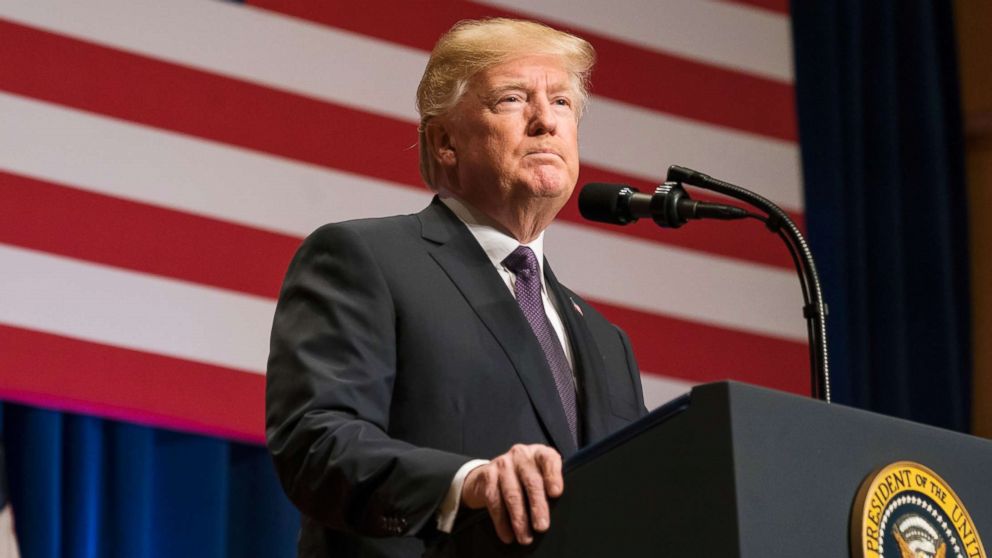
— -- Government officials in Russia and China are criticizing President Donald Trump’s new national security strategyas “imperialist” and a return to “Cold War” mentality. But Moscow's reaction also signaled that it saw some common ground.
The strategy document, announced by Trump on Monday, depicted a world where “great power competition” has returned and can only be faced down by a relentless “America First” approach. He said unrivaled U.S. strength must hold back challenges from countries like Russia and China.
“Whether we like it or not, we are engaged in a new era of competition,” Trump said in his speech. “We recognize that weakness is the surest path to conflict and unrivaled power is the most certain means of defense.”
Both China and Russia were listed among three key challenges to the U.S., and Trump referred to them as “revisionist powers,” putting them alongside “rogue regimes” like North Korea and Iran. Trump said the U.S. would seek to build a “great partnership” with the countries but always on conditions that prioritized U.S. interests.
China’s state news agency, Xinhau, reacted to the strategy by calling it a “victory for the hardliners” in Trump’s administration. A spokeswoman for China’s foreign ministry, Hua Chunying, called on the U.S. to "abandon its Cold War mentality and zero-sum game concept," warning that failure to do so "would only harm itself as well as others."
A spokesman for Russian President Vladimir Putin told reporters today that the document had a “clearly imperial nature” and demonstrated a reluctance to abandon the idea of a “unipolar world.”
The Kremlin’s reaction, however, was mixed. The spokesman, Dmitry Peskov, said he saw “positive things” in the document, noting it expressed a view of U.S.-Russia relations shared by Putin: that the two countries should cooperate in areas where it suits their interests.
“It is totally in line with our approach, voiced by the president, because Moscow also seeks cooperation with the United States in areas, which are beneficial for us, depending on how far our U.S. counterparts are ready to go," Peskov told reporters in a daily briefing call.
Trump's strategy in part also affirmed a vision of the world that aligns with one often expressed by Russian diplomats, in which states unabashedly pursue their own national interests without expressing concern for universal values. It also offered an implicit rejection of the emphasis on global cooperation that has been attributed to the foreign policy of Trump's predecessor, Barack Obama.
"The strategy is realist because it is clear-eyed about global competition: It acknowledges the central role of power in world affairs, affirms that sovereign states are the best hope for a peaceful world, and clearly defines our national interests," a White House statement that accompanied the document said.
The U.S. document nonetheless singled out Russia as interfering in the domestic political affairs of countries around the world, using “modernized forms of subversive tactics,” including cyber weapons, covert operations, state-funded media and “paid social media users or ‘trolls.’” The document did not make explicit reference to Russia’s interference last year in the U.S. presidential elections, during which American intelligence agencies have said many of those tools were employed.
Trump in his speech did refer to “new domains such as cyber and social media” that might be used to attack the U.S. But he did not explicitly refer to Russian meddling in last year's election. He focused instead on how a CIA tip had helped prevent a terrorist attack in the Russian city of Saint Petersburg, which Putin had called to thank him for on Sunday.
“That’s a great thing,” Trump said, “and the way it’s supposed to work.”
Putin spokesman Peskov also noted that incident in his call today.
Relations between the U.S. and Russia have been mired in a prolonged tit-for-tat confrontation, with both countries cutting the other’s diplomatic presence over the past year. The Kremlin has continued to reach out to Trump personally, laying the blame for the poor relations on those around him. Putin in his annual end-of-year press conference last week praised Trump.
"You have to ask him, if he has such a desire or whether it has disappeared. I hope that he has such a desire," Putin said. "We are normalizing our relations.”