Spain train crash puts human error and systemic failure under scrutiny
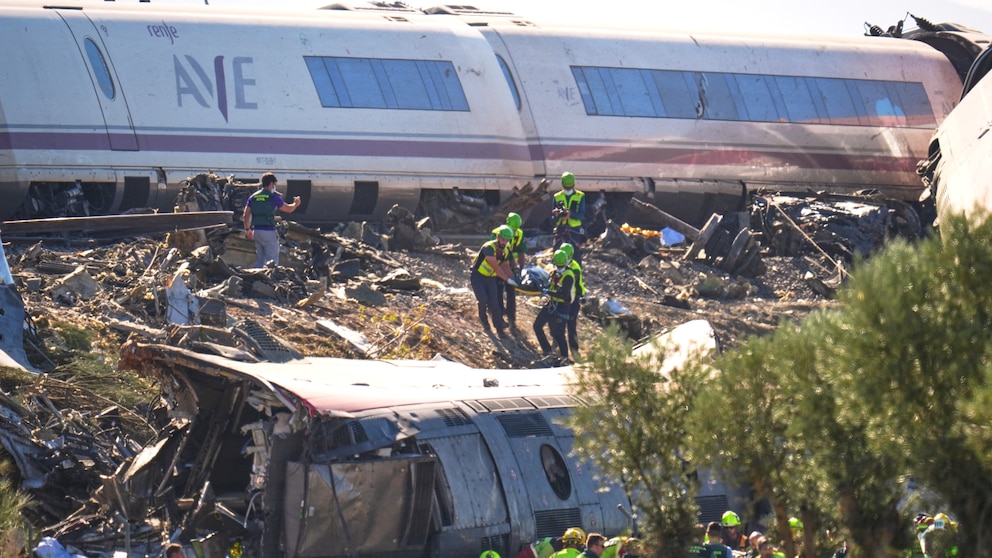
URDA, Spain -- Was Spain's second major train collision this year caused by human error or does it show severe cracks in its once touted high-speed rail network?
Spain’s transport minister has laid most of the blame on a traffic controller’s poor judgment for Wednesday's collision in Toledo province, which killed 69 people.
But railway unions have pushed back. They point to what they describe as deteriorating working conditions — fewer traffic controllers with more work than ever — that have made it increasingly difficult to ensure the safety of millions of passengers.
While the country searched for answers, police with sniffer dogs were still sifting through the wreckage on Friday. Regional authorities didn’t rule out that the death toll could still rise.
This was the second major crash on the Madrid-Seville line this year. In January, over two hours farther south, one train jumped the track and hit another going in the opposite direction, killing 46 people. That crash is still under investigation.
“It is unacceptable that a country like Spain with such a strong high-speed railway has two accidents of this type in the same year,” Spanish Prime Minister Pedro Sánchez said Friday from the crash site near the town of Urda.
Spain’s high-speed rail network has been considered a success of state industrial policy. It is the world’s second-largest, after China’s. Until this year, it had not experienced a deadly crash since coming into service over three decades ago.
The chain of events that ended in disaster started at 8:31 a.m. on Wednesday, when the communication system key to the functioning of the security system on the Madrid-Seville line went down. The system, called LZB, monitors the position of trains with digital sensors and can automatically apply their brakes to prevent a collision.
The backup safety system, which is the primary system on older, low-speed commuter lines, didn't help out because the trains were both inside the same stretch between two analogue sensors.
That meant that traffic controllers based at a control post in Madrid took over full responsibility for monitoring the positions and safety of the trains on a stretch of 63 kilometers (39 miles). At the time of the accident, there were 16 controllers in the control post and two monitoring the Madrid-Seville line.
At 8:36, a controller told one train, belonging to state-owned RENFE, that it could start running again at normal speed. The other train, operated by privately owned IRYO and located 15.5 miles (25 kilometers) down the line, also tried to restart, but the engineer was unable to restart the train. The IRYO conductor told the control center, but the RENFE train was not told to stop.
Recordings leaked to Spanish media contain snippets of apparently hectic conversations between the engineers on the trains and the traffic controllers in Madrid in the minutes before the accident.
At 8:53, the collision occurred, derailing carriages and shredding parts of the trains to bits.
The independent investigators said their initial findings indicated that the RENFE train was moving at between 160 and 200 kph (100-125 mph) when it struck the IRYO train.
Transport Minister Óscar Puente, who is under pressure to resign, called the controller's decision to let one train restart at full speed while the other remained stationary “inexplicable” and “erroneous" when he spoke to the media in the immediate aftermath of the crash.
“I won’t use a worker as a shield,” Puente told reporters in a 2-hour-long news conference Friday, but added that “the information points to a mistake in the control center.”
Unions, however, argue that the context matters.
Raquel Ayllón, spokesperson for SCF, Spain’s railway traffic controllers union, told The Associated Press that the workload is regularly too much for the current staff to safely handle.
“We believe (the minister) is blaming a mere worker who was working under increasingly poor conditions,” Ayllón said. “Human error isn’t incomprehensible. What is incomprehensible is that the safety system is regularly failing.”
The liberalization of Spain's high-speed rail and the entrance of private train companies have caused a huge jump in traffic in just a few years. Spain went from 35 million train travelers in 2019 to 49 million in 2024, according to the Spanish National Markets and Competition Commission.
Both of this year’s collisions involved a train operated by RENFE and one operated by IRYO.
“We are not convinced that the liberalization of the high-speed passenger rail service was matched by the necessary upkeep of the lines,” said Joan Rodríguez of Spain’s train workers’ union.
Puente defended his ministry, saying it increased the staff of train traffic controllers from 1,000 in 2016 to 1,700 now.
Spain's union for train engineers, SEMAF, said that the three-decade-old LZB train security system, which is still in use on the Madrid-Seville line while being phased out, consistently goes offline.
“The LZB system should have been replaced some time ago,” said Diego Martín, spokesperson of the SEMAF.
Puente acknowledged that the German-made LZB system regularly goes offline due to many factors, including damage to infrastructure from vandalism, maintenance work and bad weather. He said it has gone offline 170 times this year, but that is “normal” within the average of recent years.
The minister added that Spain is ahead of most other European countries in replacing it with a new system demanded by the European Union.
Investigators from a special committee for rail accidents removed the trains’ black boxes late Thursday and gave them to the Civil Guard for inspection. A judge is also investigating the crash.
Seventy families have presented missing persons reports to police for unaccounted-for passengers. Only five bodies have been identified so far. Thirty-nine people remain hospitalized on Friday from the over 200 who were injured.
___
Wilson reported from Barcelona, Spain.