• Video
  • Shop
  • Culture
  • Family
  • Wellness
  • Food
  • Living
  • Style
  • Travel
  • News
  • Book Club
  • Newsletter
  • Privacy Policy
  • Your US State Privacy Rights
  • Children's Online Privacy Policy
  • Interest-Based Ads
  • Terms of Use
  • Do Not Sell My Info
  • Contact Us
  • © 2026 ABC News
  • News

Sun releases 4 strong solar flares: What to expect
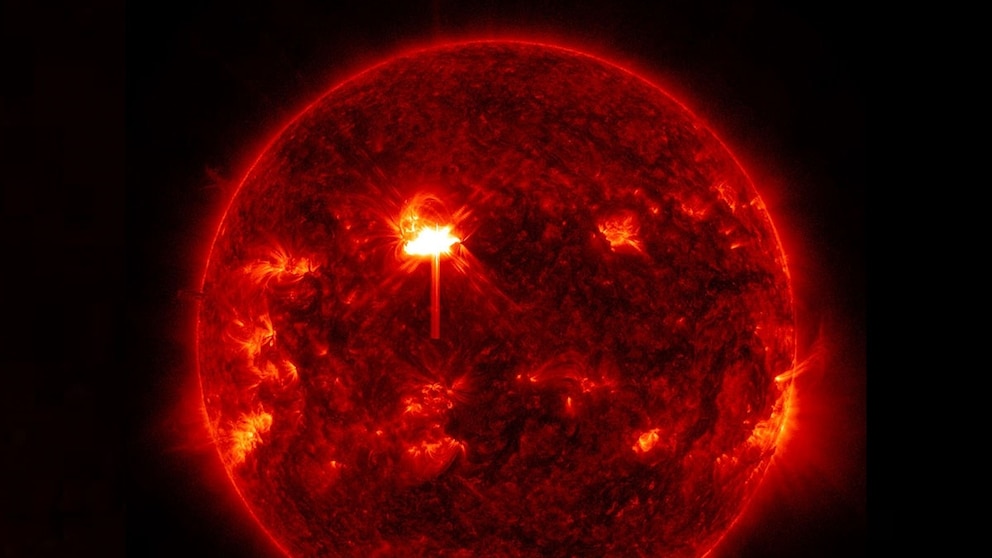
1:43
Strong solar storm hitting Earth could produce northern lights in the US
NASA/SDO
ByJulia Jacobo
February 03, 2026, 7:54 PM

The sun has emitted several solar flares in recent days, putting space-weather experts on the lookout for northern lights displays and disruptions in satellite technology.

On Sunday, the sun released three strong solar flares: One at 7:33 a.m. ET, the second at 6:37 p.m. ET and the third at 7:36 p.m. ET, according to NASA.

Related Articles

'Severe' geomagnetic storm could make northern lights visible in southern US

A fourth solar flare occurred on Monday at 3:14 a.m. ET, the space agency said.

Solar flares are large eruptions of electromagnetic radiation from the sun, which could last from minutes to hours, according to the National Oceanic and Atmospheric Administration's Space Weather Prediction Center. They typically take place in active regions of the sun, or areas marked by the presence of strong magnetic fields -- typically associated with sunspots.
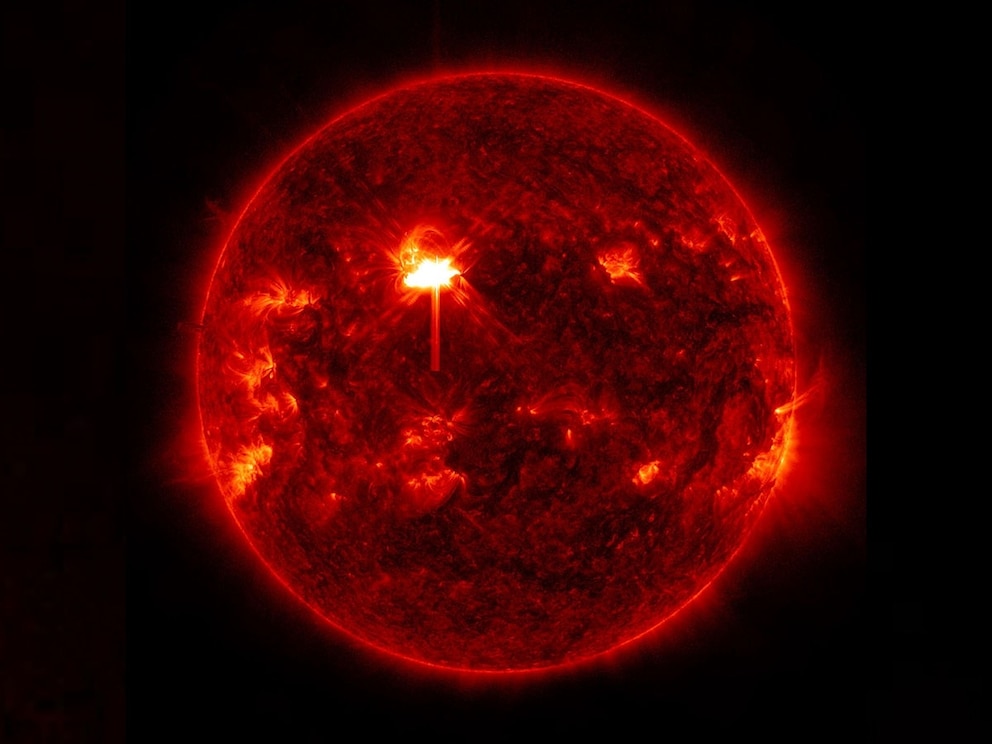
PHOTO: NASA’s Solar Dynamics Observatory captured this image of a solar flare — seen as the bright flash in the Sun’s upper half — on Feb. 3, 2026.
NASA’s Solar Dynamics Observatory captured this image of a solar flare — seen as the bright flash in the Sun’s upper half — on Feb. 3, 2026. The image shows a subset of extreme ultraviolet light that highlights the extremely hot material in flares and which is colorized in red.
NASA/SDO

Each of the solar flares emitted this week were classified within the "X-class," which denotes the most intense types of flares, according to NASA.

Flares of this magnitude are generally not common, according to the Space Weather Prediction Center.

The second solar flare to occur on Sunday was classified as a massive X8.1 flare, the strongest in several years, records show.

Related Articles

NOAA forecasts strong geomagnetic storm for Tuesday: What to expect

Since the sudden outburst of electromagnetic energy travels at the speed of light, it can cause signal loss in high frequency communication bands over much of the sunlit side of Earth, according to NOAA. Users could experience loss of contact or major disruptions for a number of minutes to a couple of hours in the affected areas.

Solar flares are often precursors to Coronal Mass Ejections (CME) -- a massive burst of solar material and magnetic field from the sun's outer atmosphere.
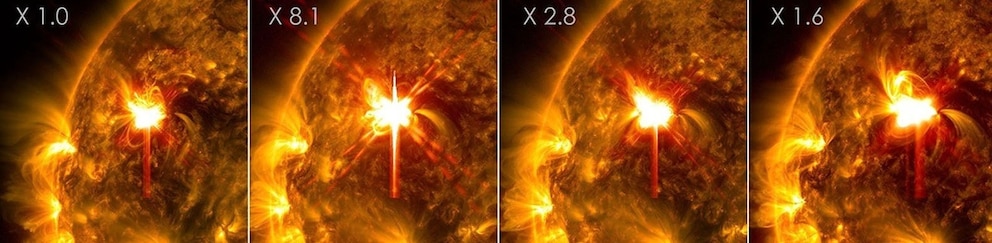
PHOTO: NASA’s Solar Dynamics Observatory captured these images of the solar flares — seen as the bright flashes in the center of the images — on Feb. 1 and Feb. 2, 2026.
NASA’s Solar Dynamics Observatory captured these images of the solar flares — seen as the bright flashes in the center of the images — on Feb. 1 and Feb. 2, 2026. The images show a subset of extreme ultraviolet light that highlights the extremely hot material in flares and which is colorized in gold and red.
NASA/SDO

Northern light displays occur when a solar flare interacts with the atoms and molecules in Earth's atmosphere.

As the solar flare clashes with the upper atmosphere, it causes the atoms to emit a glow, creating a spectrum of light in the night sky.

Whether the auroras will actually be visible will depend on how the CME arrives, the magnetic orientation of the CME's magnetic field and how cloudy it is locally.

Related Articles

NASA to launch 2 new satellites that will help forecast solar storms

In October 2024, the sun's magnetic field reached its solar maximum phase of its 11-year cycle.

The sun has continued to emit strong solar flares and geomagnetic storms ever since, leading to an increase in frequency of northern lights.

Intense magnetic activity caused by sunspots is expected to last through 2026, according to NOAA.


Up Next in News—

New York Gov. Kathy Hochul announces moratorium on data centers

July 14, 2026

Capt. Chesley 'Sully' Sullenberger reveals Alzheimer's diagnosis

July 14, 2026

Man recovering from surgery after bison attack at Yellowstone, as wildlife experts share safety warning

July 13, 2026

Family dog gets in between charging bear and young boy

July 7, 2026

Shop GMA Favorites

ABC will receive a commission for purchases made through these links.

Sponsored Content by Taboola

The latest lifestyle and entertainment news and inspiration for how to live your best life - all from Good Morning America.
  • Contests
  • Terms of Use
  • Privacy Policy
  • Do Not Sell My Info
  • Children’s Online Privacy Policy
  • Advertise with us
  • Your US State Privacy Rights
  • Interest-Based Ads
  • About Nielsen Measurement
  • Press
  • Feedback
  • Shop FAQs
  • ABC News
  • ABC
  • All Videos
  • All Topics
  • Sitemap

© 2026 ABC News
  • Privacy Policy— 
  • Your US State Privacy Rights— 
  • Children's Online Privacy Policy— 
  • Interest-Based Ads— 
  • Terms of Use— 
  • Do Not Sell My Info— 
  • Contact Us— 

© 2026 ABC News