Underwater Crash Survival: Watch ‘GMA’ Correspondent Matt Gutman Escape Sinking Plane, Boat
— -- For Ferdinand Puentes and nine others, their flight bound for Honolulu was routine -- until their small plane rattled, lost altitude and crashed into the ocean.
Because Puentes was wearing a camera, what happened next was all caught on tape.
“It was as if time stopped and everything you remembered in your past, loved ones -- I didn't say goodbye to them. Your whole life just goes in front of you,” he said of the crash on Dec. 11, 2013.
As the water rushed in, the passengers managed to escape before the plane sank. One of those passengers – Hawaii's state health director, 65-year-old Loretta Fuddy – died shortly afterward of a cardiac arrhythmia caused by stress, but the others lived.
Those who fly may think the passengers who got out of the plane were just incredibly lucky, but if a plane crashes into the water, the U.S. Coast Guard says there are things people can do to increase their chances of getting out alive.
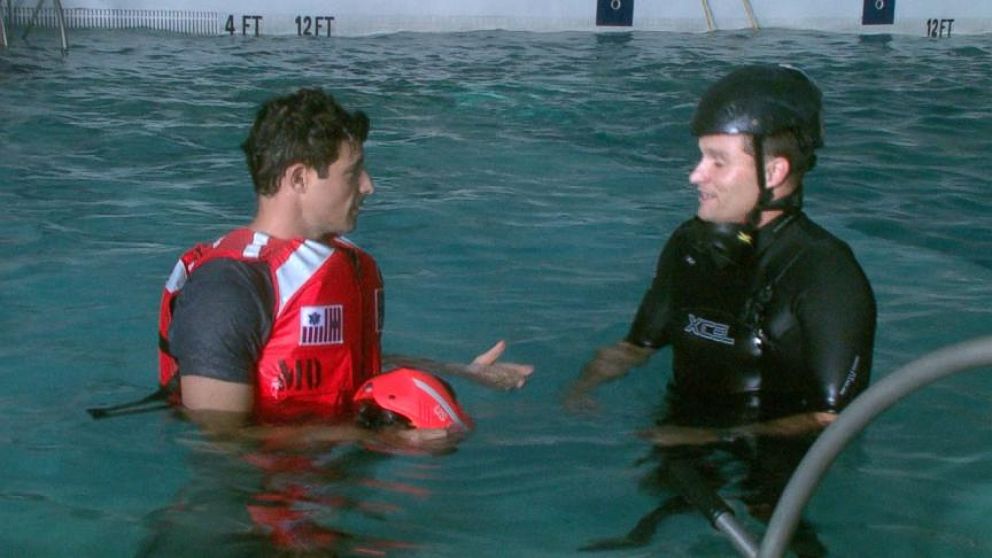
“Good Morning America” correspondent Matt Gutman is the first reporter to ever go through the Coast Guard’s grueling crash survival training in at Aviation Technical Training Center in Elizabeth City, North Carolina.
Gutman’s training ground was an aircraft simulator known as the Dunker, which simulates a plane crashing, sinking and flipping over in the water.
Before the exercise begins, Dave Bradbury tells Gutman that if he gives the signal, monitors can release all the seatbelts and hovering divers can give him fresh air immediately.
“This is not going to be easy,” Gutman, dressed in a flight suit, vest and boots, tells the camera.
First, Gutman is given a quick test to see if he can tolerate being strapped in and upside down underwater, as he would be in a crashed plane.
Gutman didn’t expect to be disoriented at all, but he was.
“It happened instantly and you just kind of calm down,” he said.
Bradbury’s advice: “Staying calm is the key to coming out alive.”
Gutman then goes to the Dunker, where the crash simulation begins.
The instructors give him a few key pointers. First, they say to hold on to something, like your seat, as a reference point before you unbuckle your seatbelt.
After the crash, the instructors say you should remove any obstacles – such as armrests. Passengers should then unbuckle their seatbelts and get to a door or window as quickly as possible.
Gutman says his first dunk was frightening, but he made it out.
The second one was more difficult. Conditions simulated a storm, and the water engulfed him. Hanging upside down, he had to go through a window.
He followed all the steps as he had been instructed – clearing obstacles and unbuckling his belt – before heading for the window.
It wasn’t easy. Gutman said he couldn’t see anything, calling it “sensory deprivation.”
To make matters worse, the window wouldn’t open. Gutman -- submerged and holding his breath -- slapped and pushed the window for about 40 seconds before finally popped open and he was able to get out.
The hardest scenario was yet to come. This time, the Dunker simulated a boat capsizing in the open ocean, where it was dark and windy.
Despite those conditions and the changed vessel, Gutman learned the way to escape hadn’t changed: find a reference point, eliminate obstacles, unbuckle their seatbelts and get to the door.
When the boat capsized, Gutman removed his seatbelt and got to the door, but found that it had three handles. Not knowing which would open the door, he turned the wrong one, wasting precious time.
Nearly a minute into the underwater escape, he’s running out of air.
He had to signal the rescuers, who instantly yanked him out of the simulator.
Rescuers say passengers need to familiarize themselves with their surroundings before anything happens, and remember: reference point, obstacle, seat belt, out.