Why 5-Year-Old Kids Can Do Algebra
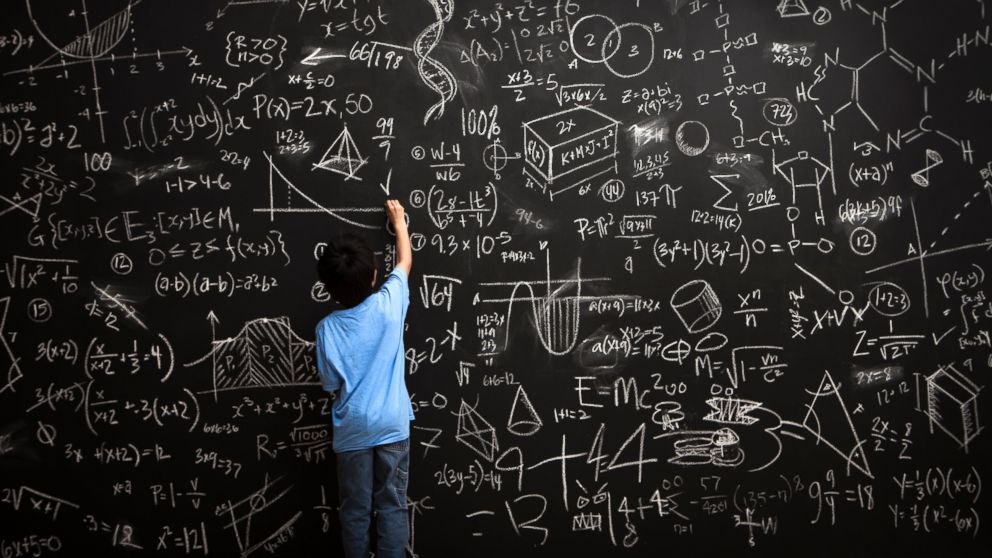
March 16, 2014— -- Find algebra difficult? Well, think about this: Scientists find that even 5-year-old kids can do it.
Now do you feel better?
If not, maybe this will help. Preschoolers can do basic algebra -- and we do mean very basic -- through gut instincts that we share with a lot of other animals, but by the time we get fully involved in the educational process algebra will become a lot more difficult.
Our natural instincts with numbers will be "replaced by rule-based problem solving," and that can be a lot harder, psychologist Melissa Kibbe of Johns Hopkins University said in a telephone interview. She is the lead author of a study published in the journal Developmental Science.
Kibbe and psychologist Lisa Feigenson, director of the Johns Hopkins Laboratory for Child Development, put 136 children, age 4-6, through 136 experiments in a Baltimore science museum to see if the preschoolers could solve a basic algebraic problem -- finding the quantity of "X," an unknown value.
The purpose of the experiments was to broaden the understanding of something we are all born with, known as the "approximate number system," but also referred to as "number sense" in the scientific literature.
Humans, like many animals, have an inborn ability to determine the number of objects in our immediate environment. That's probably part of our evolutionary history. It would have been convenient to know if the predator confronting a hunter-gather was one wolf, or a pack of wolves.
Kibbe said the approximate number system probably makes it possible for us to learn how to count and eventually do math, including algebra and trig and all those other fun things.
The first two of five experiments tested the kids' ability to understand symbols, like words or numbers, to solve a simple problem. The children got the right answer 46 percent of the time, which was no better than chance since there were only two choices. So they failed.
The three remaining experiments used stuffed animals as symbols and the kids were asked to figure out roughly how many tokens the animals contributed to another pile of tokens. They didn't need to know the number: They just had to figure out if the animal had added a few tokens, or a lot. As in algebra, they were charged with finding an unknown value.
"The children nailed it," Feigenson said. "We found that young children are very, very good at this. It appears that they are harnessing their gut level number sense to solve this task."
In fact, the kids got it right about three-fourths of the time, so they really understood that if you add 12 tokens to a pile, the pile grows a lot more than if you add four tokens. It's not necessary to know the exact numbers. If the pile is a lot bigger, then x=12; if it's just a little bigger, then x=4. That's number sense.
A couple of years ago a Johns Hopkins colleague, Justin Halberda, collected data from more than 10,000 Internet subjects, ages 11 to 85, and found that "number sense" improves during school years, but declines during old age. And, it remains linked to our ability to do math throughout our entire lives.
Interestingly, the Kibbe study found no difference in gender or in ages in the ability to "solve for the unknown quantity." That's a little surprising because many studies have shown that boys outperform girls in math after they enter school.