Chris Borland's Early NFL Exit Doesn't Mean Avoiding Brain Damage, Experts Say
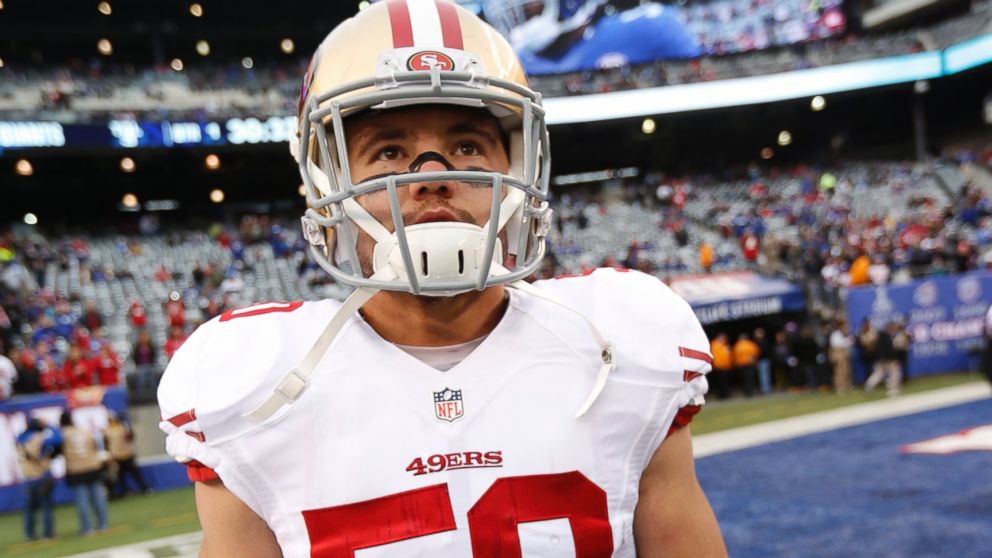
— -- Chris Borland's retirement, announced earlier this week, means the San Francisco 49ers rookie linebacker might be walking away from millions of dollars in potential earnings. But he could also be walking away from the long-term effects of repeated traumatic brain injuries.
Borland, 24, told ESPN earlier this week that he made his decision after consulting with those close to him and studying what is known about the relationship between football and neurodegenerative disease. His fears could be well-founded, according to the latest research.
Chronic traumatic encephalopathy (CTE), a degenerative brain disease, has been linked to repeated head trauma experienced by National Football League players and other professional athletes who report a high rate of concussions and sustain repeated blows to the head. Depression, mood swings and memory loss, as well as early onset dementia, Alzheimer's or Parkinson's disease are just a few of the symptoms associated with the condition, according to the American Association of Neurological Surgeons.
Currently, the only reliable diagnosis for CTE comes after death. The most up-to-date autopsy statistics assessing the rate of CTE ranges from 50 to 97 percent of the former NFL players who have donated their brains to research, according to a review of studies by the University of California at San Francisco published last week in the journal Molecular and Cellular Neuroscience.
But even as Borland walks away from a pro career, he told ESPN that he had already sustained two significant concussions while playing sports in high school and college. And lasting damage to the brain likely occurs long before an athlete signs on with the pro leagues, explained Dr. Alison Cernich, the director of the National Center for Medical Rehabilitation Research.
"The problem is we don't know much about who gets CTE or why certain people get it and other people don't," Cernich said.
While it seems clear that multiple head injuries increase risk of CTE, it's less certain how many hits to the head it might take to send someone's brain over the edge, Cernich said. Nor is it clear if timing of the injuries matters.
Borland did not immediately respond to requests from ABC News seeking additional comment.
Harvard neurologist Dr. Marie Pasinski said she believed that brain trauma almost certainly begins in the years before an athlete enters the professional arena. She views CTE as a kind of overuse syndrome, the result of repeated damage that accumulates over time rather than one catastrophic event.
"We are starting to realize problems occur much earlier than we initially thought," Pasinski said. "Even with one mild traumatic brain injury we can now see changes to the brain on MRI."
Harm from mild, "subclinical" head traumas adds up, Pasinski noted. Shots to the head that don't necessarily cause obvious symptoms lead coaches and trainers to assume -- mistakenly -- that a player is fine to get back in the game, she said, and sometimes athletes keep quiet about this type of injury because they want to keep playing.
"There is still a pervasive belief that only a concussion serious enough to knock the athlete out will do damage, but that's not the case," Pasinski said. "Any blow to the head that leaves a person slightly dazed or not quite right may cause harm to the brain."
Cernich said there is no reliable way to tell who will experience the long-term problems. Researchers look for markers such as changes to certain brain proteins and locations where these proteins accumulate but there is not yet enough evidence to determine if damage that occurs early on will lead to symptoms later in life.
The NFL issued a statement saying the league respects Borland's decision and wishing him all the best.
"By any measure, football has never been safer and we continue to make progress with rule changes. ... We continue to make significant investments in independent research to advance the science and understanding of these issues," the statement read.
"We know that not everyone who plays football has CTE or will get CTE," Cernich said. "Everyone has to evaluate their own situation and decide how much of a risk they're willing to take."
Dr. Shawn Shah with ABC News' medical unit and ABC News' Gillian Mohney contributed to this report.