COVID-19 has been compared to the flu. Experts say that's wrong.
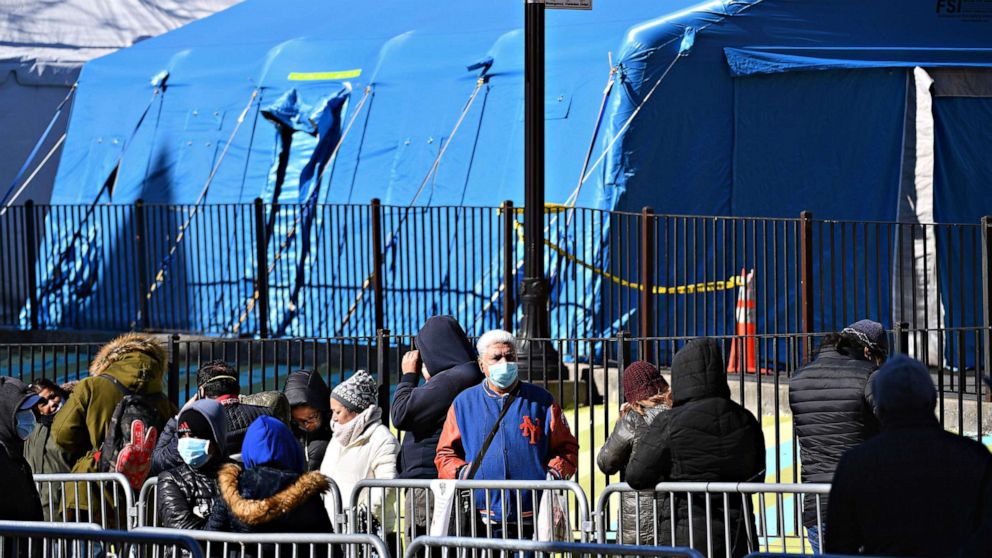
Even with businesses closed, travel restricted and shelter-in-place orders issued around the world, many still wonder if such extremes are needed to battle the novel coronavirus.
Some people, including the president of the United States, have said COVID-19 isn't too different from the common flu.
But, according to experts, is COVID-19 actually worse?
The short answer? Yes.
Tune into ABC at 1 p.m. ET and ABC News Live at 4 p.m. ET every weekday for special coverage of the novel coronavirus with the full ABC News team, including the latest news, context and analysis.
An estimated 35 million Americans were infected last flu season, and about 500,000 were hospitalized. Approximately 35,000 died.
Even with more than 10% of the U.S. population affected by the flu most years, those are stunning numbers. But businesses aren't closed and people aren't asked to stay home.
What's different now?
COVID-19 in a novel virus, which means it's new. Although similar to SARS and MERS, it's wrong to assume it will follow the same path as its coronavirus cousins -- indeed, COVID-19 already has spread far beyond either of them.
So although the seasonal flu, at least to this point, has killed more Americans, COVID-19 appears more deadly and definitely spreads more quickly.
In other words, experts told ABC News, it's not the seasonal flu.
So exactly how much worse is it? Consider this chart, which compares COVID-19 to the flu using the most recently compiled statistics.
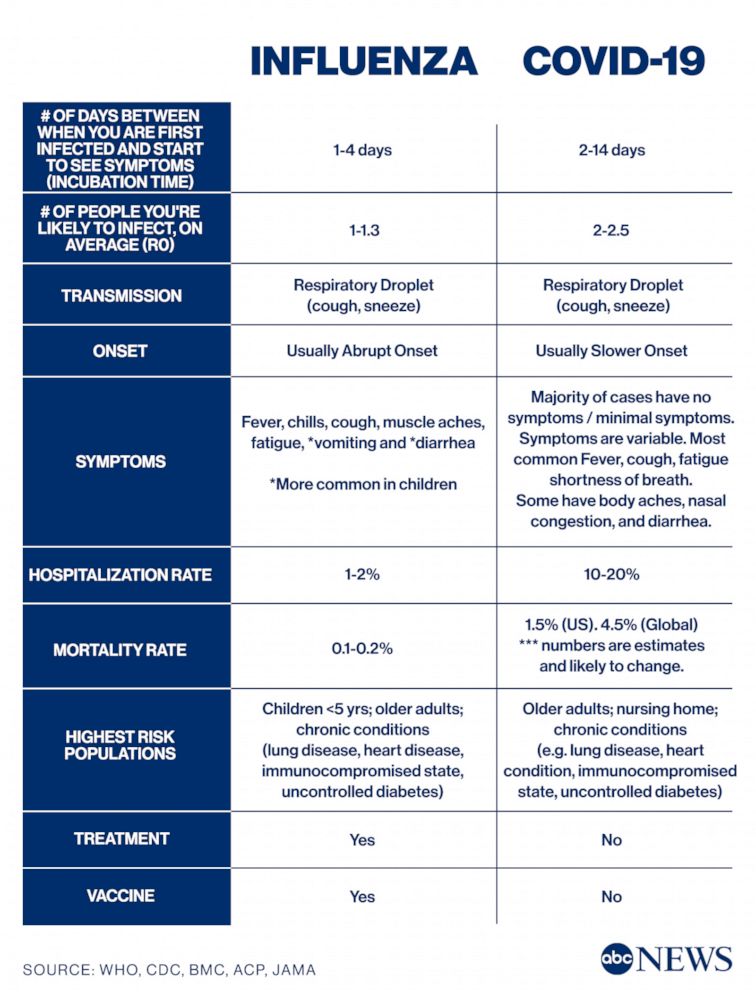
It's still unclear exactly how deadly novel coronavirus is. The death rate may be overestimated because testing hasn't been ramped up and there could be hundreds of thousands or even millions not counted globally because they never get sick or show symptoms. The death rate, at least so far, similarly could've been affected by variables that have nothing to do with the virus itself, including overwhelmed hospitals, which contributed to Italy's estimated mortality rate of about 7%.
Perhaps most important, COVID-19 remains extremely dangerous because so many people show minimal or no symptoms -- a phenomenon often called "a silent infection." This can accelerate person-to-person transmissions because carriers of the virus simply don't know they have it.
"This disease seems to respond to social distancing, and so we can help reduce the number of people dying of COVID-19," said Dr. Pritish Tosh, medical director for Emergency Management at the Mayo Clinic. "This is not overhyping. These rather unprecedented social maneuvers are likely to help to keep otherwise vulnerable people from getting sick and dying."
More pronounced symptoms tied to COVID-19 probably would have slowed its spread.
"In general, when the flu hits you, people lie in bed and don't go out," said Dr. Simone Wildes, an infectious disease specialist at South Shore Health. "But something we are seeing with COVID-19 is that because the symptoms are mild for most of the population, they can go out and spread the disease quite easily, especially given how long you can be infectious for."
Fortunately for most patients, COVID-19 infections have proven mild, but current statistics still support recent statements by Dr. Anthony Fauci, director of the National Institute of Allergy and Infectious Diseases and White House Coronavirus Task Force expert, that COVID-19 is over 10 times as lethal as the flu.
Although they could quickly change, current data paints a morbid picture.
Especially because there isn't a current treatment.
Especially because there isn't a vaccine.
Especially because no one's really sure how this pandemic will unfold.
Vinayak Kumar, M.D., MBA, is an internal medicine resident at the Mayo Clinic and a contributor to the ABC News Medical Unit.