What You Should Know About Early-Onset Alzheimer’s
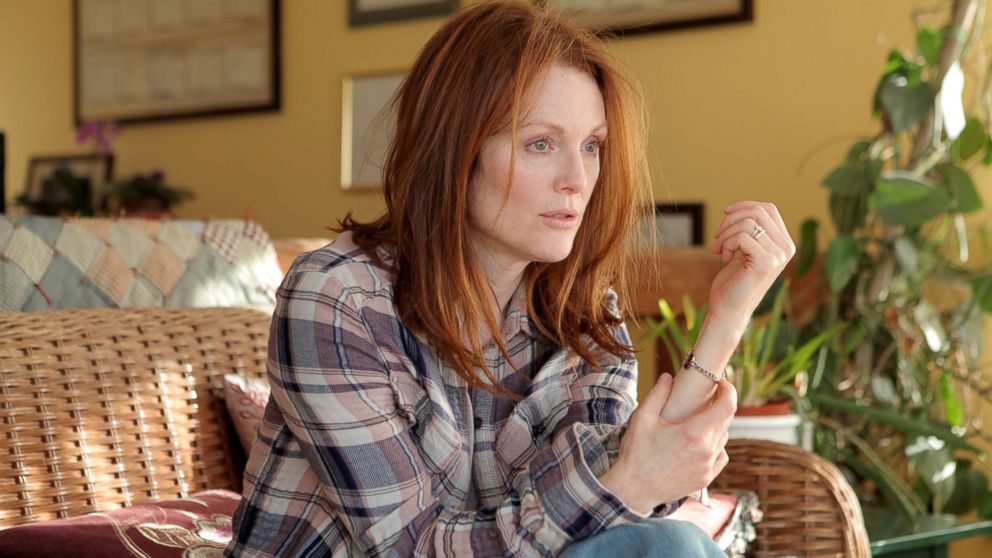
— -- intro:Julianne Moore won a Golden Globe and is nominated for an Academy Award for her portrayal of an early-onset Alzheimer’s patient in the film Still Alice. Moore’s character, Alice Howland, is just 50 when she is diagnosed, and the movie follows her and her family’s struggle to cope as her memory and mental state decline.
But what is early-onset Alzheimer’s disease, and who is at risk? Here’s what you should know about the condition that affects about 200,000 people in the United States.
25 Signs and Symptoms of Alzheimer’s Disease
quicklist: 1category: What You Should Know About Early-Onset Alzheimer’stitle: Not just for old peopleurl:text:Alzheimer’s disease is usually thought of as something senior citizens get. While that is often true, it’s not always the case: Up to 5% of people diagnosed with Alzheimer’s are under age 65—usually in their 40s or 50s—and are considered to have an “early onset” or “younger onset” of the disease.
Symptoms of early-onset Alzheimer’s are no different than symptoms of more traditional cases, says Mary Sano, PhD, professor of psychiatry and director of Alzheimer’s disease research at Mount Sinai School of Medicine in the Bronx, whom Moore consulted during her research for Still Alice. But because the condition is so rare in adults under 65, the signs may not be recognized as quickly by patients themselves, or by those around them.
“By the time people ask for help, something strange has probably been going on for at least six months,” says Sano. “And often, it’s family members and close friends who can provide a point of view that a change has occurred, which can allow that person to realize something is wrong.”
Because early-onset Alzheimer’s disease is so uncommon, diagnosis may also require testing above and beyond what a senior citizen might undergo. “We want to demonstrate that what’s really present is a cognitive problem and not a psychological or physical problem,” says Sano. “For a younger person, we’ll do a more rigorous workup, including imaging and other tests, because we want to make sure we get this right.”
Early-onset disease has a strong genetic component, so family history—if the patient knows enough about it—can be a big part of a person’s diagnosis, as well. A blood test can determine whether someone has a gene mutation that puts them at higher risk for familial Alzheimer’s, but cannot prove whether they have (or will get) the disease.
quicklist: 2category: What You Should Know About Early-Onset Alzheimer’stitle: What it’s like—and what it’s noturl:text:First things first: Early-onset Alzheimer’s disease is uncommon, and it’s not responsible for most cases of middle-aged forgetfulness—like not being able to remember where you put your keys, or the name of someone you met at a cocktail party last night, for example.
Episodes like these, says Sano, are most likely due to preoccupation or periods of temporary stress, and usually aren’t anything to worry about.