NASA's Kepler Telescope Captures 'Brilliant Flash' of Supernova Shockwave for 1st Time Ever
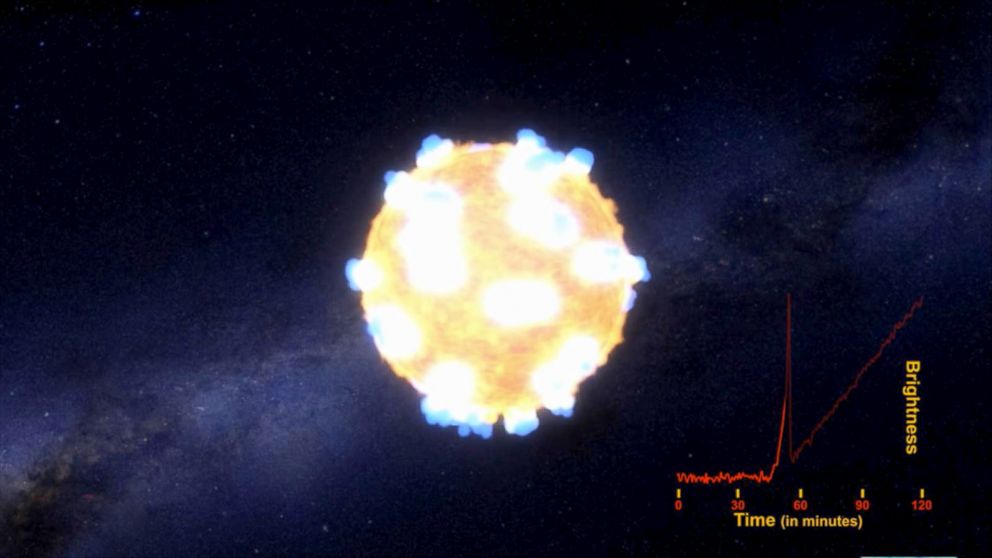
— -- The "brilliant flash" that occurs when a star dies and explodes has been captured for the first time in visible light by NASA's Kepler space telescope, according to NASA's Ames Research Center.
Though the animation above shows an artist's interpretation of the phenomenon known as a shock breakout, the art is based on newly published data and never-before captured optical wavelength images collected by the Kepler telescope, NASA said on a feature post on its official website on Monday.
Kepler has been searching for signs of supernovae among 50 trillion stars in 500 distant galaxies every 30 minutes for the past three years, according to the Ames Research Center.
The center added that the shock breakout -- or the early flash a star emits when it begins blowing itself apart -- lasts for about only 20 minutes, so catching it was a "milestone for astronomers."
Though the shock breakout was caught in 2011, the discovery was made public on Monday after the research paper reporting the discovery's findings was accepted for publication in the Astrophysical Journal, scientists explained.
The flash was emitted from the explosive death of a star known as KSN 2011d, which was roughly 500 times the size of our sun and about 1.2 billion light-years away, according to Ames.
To put its size in perspective, "Earth's orbit about our sun would fit comfortably within these colossal stars," said Peter Garnavich, an astrophysics professor at the University of Notre Dame in Indiana who led the international team that analyzed Kepler's findings for Ames.
Researching the physics of the violent ends of stars allows scientists to "better understand how the seeds of chemical complexity and life itself have been scattered in space and time in our Milky Way galaxy," according to Ames.
"All heavy elements in the universe come from supernova explosions," said Steve Howell, a project scientist for NASA's Kepler and K2 missions.
"For example, all the silver, nickel, and copper in the earth and even in our bodies came from the explosive death throes of stars," he said. "Life exists because of supernovae."
A star beings to run out of fuel once it creates heavier elements through fusion reactions, and if the star is massive enough, that star will collapse on itself, leading to a supernova.