• Video
  • Shop
  • Culture
  • Family
  • Wellness
  • Food
  • Living
  • Style
  • Travel
  • News
  • Book Club
  • Newsletter
  • Privacy Policy
  • Your US State Privacy Rights
  • Children's Online Privacy Policy
  • Interest-Based Ads
  • Terms of Use
  • Do Not Sell My Info
  • Contact Us
  • © 2026 ABC News
  • News

Powerful solar weather brings northern lights farther south

0:46
What to know about northern lights that could be visible tonight
Lance King/Getty Images, FILE
ByKyla Guilfoil
August 19, 2022, 6:23 PM

The Northern Lights may be visible as far south as Pennsylvania and Iowa on Friday, Space Weather Prediction Center from the National Oceanic and Atmospheric Administration said.

The remarkable sky lights may come down farther south due to a geomagnetic storm that began on Wednesday, experts said.

The storm is the result of a coronal mass ejection, or CME, which is a powerful burst of magnetized plasma from the sun’s corona, its outermost layer.

Scientists detected two CMEs erupting on the sun and aimed for Earth, which they expected to arrive on August 18.

Related Articles

MORE: 'Spanish Stonehenge' has reemerged amid Europe's sizzling drought

The CMEs can combine to create a geomagnetic storm, scientists say, to reach strong levels that may create auroras closer to the equator than usual.

The auroras, which make up what we know as the Northern Lights, form when high-energy particles from the sun collide with Earth’s atmosphere. The particles glow because they excite the gasses in the sky.

Stronger energy brings the glowing particles farther from the poles, experts say.
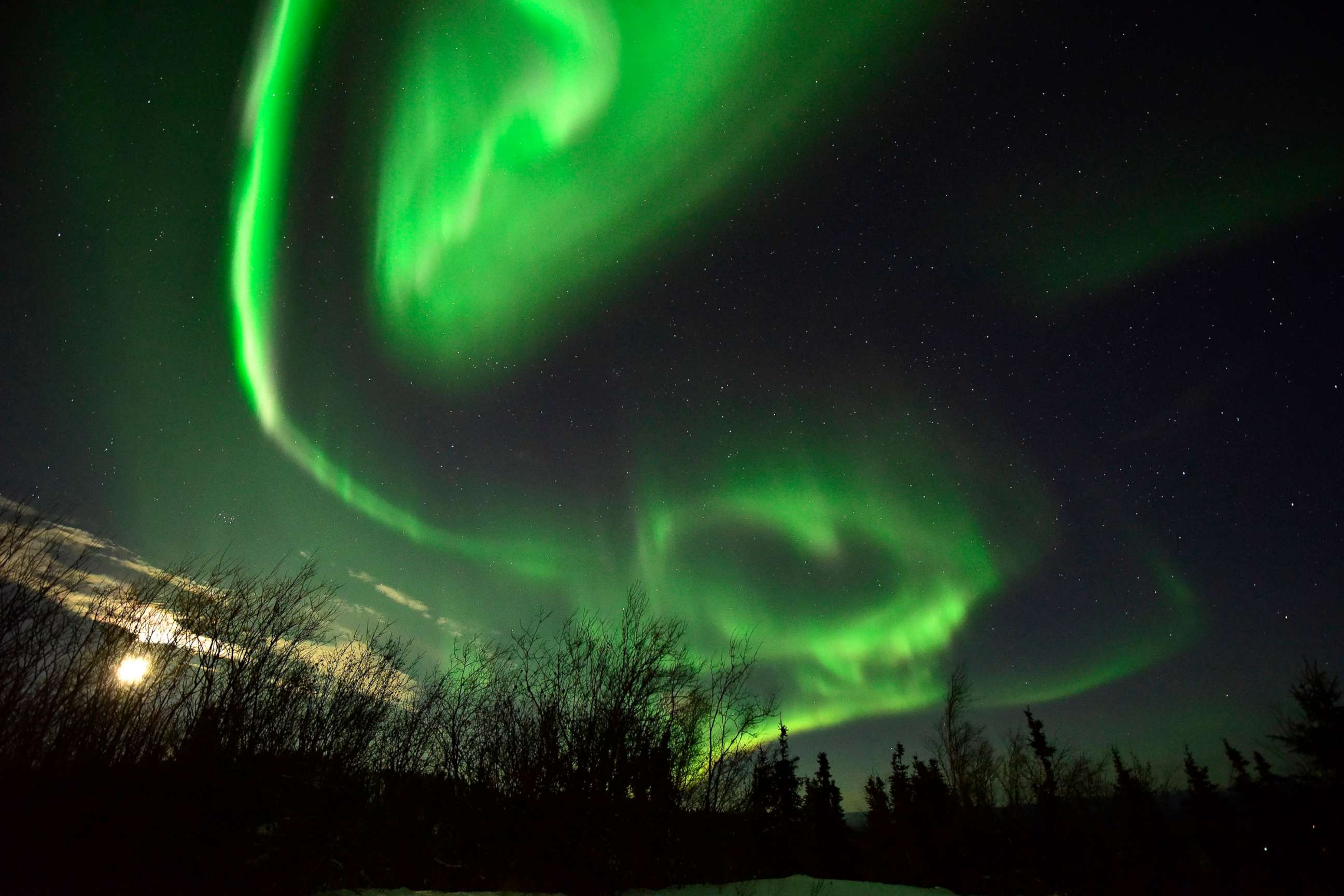
PHOTO: The Aurora Borealis, also known as the Northern lights, appears in the sky, Jan. 8, 2017, west of Fairbanks, Alaska.
The Aurora Borealis, also known as the Northern lights, appears in the sky, Jan. 8, 2017, west of Fairbanks, Alaska. The Aurora Borealis is a result of the interaction between solar wind and the earth's magnetosphere.
Lance King/Getty Images, FILE

Leading up to the stronger storm, scientists said a coronal hole high-speed stream arrived on Thursday night to create a more minor geomagnetic storm.

A coronal hole is a cooler area in the sun’s outermost layer that can generate high-speed solar wind that is full of charged particles that can get spread across the solar system.

These high-speed streams can create auroras on Earth, too.

Related Articles

MORE: North Atlantic hurricane season could soon shift earlier in the year, scientists say

Typically, auroras are most visible from December to February, but viewers have strong chances from September to November, too, experts say.

Stronger solar weather is needed for such a view in the summer months.

Alaska is known as a top U.S. destination for seeing the lights, but visitors can also expect a view in northern Maine during favorable conditions, scientists say.

Experts say that less densely populated areas, where the night sky remains darkest, are most favorable for northern viewing of the magical sky lights.


Up Next in News—

This San Francisco shop is run completely by an AI agent

April 23, 2026

Mother charged after teen son allegedly hits and injures 81-year-old veteran while riding e-motorcycle

April 23, 2026

UK bill banning smoking products for those born after 2008 is one step away from becoming law

April 22, 2026

Pilot killed in Florida plane crash hailed as hero

April 21, 2026

Shop GMA Favorites

ABC will receive a commission for purchases made through these links.

Sponsored Content by Taboola

The latest lifestyle and entertainment news and inspiration for how to live your best life - all from Good Morning America.
  • Contests
  • Terms of Use
  • Privacy Policy
  • Do Not Sell My Info
  • Children’s Online Privacy Policy
  • Advertise with us
  • Your US State Privacy Rights
  • Interest-Based Ads
  • About Nielsen Measurement
  • Press
  • Feedback
  • Shop FAQs
  • ABC News
  • ABC
  • All Videos
  • All Topics
  • Sitemap

© 2026 ABC News
  • Privacy Policy— 
  • Your US State Privacy Rights— 
  • Children's Online Privacy Policy— 
  • Interest-Based Ads— 
  • Terms of Use— 
  • Do Not Sell My Info— 
  • Contact Us— 

© 2026 ABC News