Rare exoplanet discovered in outskirts of the Milky Way

Astronomers have located a rare exoplanet on the edge of the Milky Way.
The exoplanet, a gas giant named AT2021uey b, orbits a low-mass star and is located about 3,200 light-years away from Earth, according to a paper published last month in the journal Astronomy & Astrophysics. Its orbit around an M dwarf star -- a relatively small and cool star -- completes every 4,170 days.
The researchers used a technique known as gravitational microlensing -- a method based on Albert Einstein's theory of general relativity -- to locate the planet. The presence of mass warps the fabric of space-time, similar to how a bowling ball would make a dent when placed on a trampoline, according to NASA. The effect is extreme around "very massive" objects, such as black holes and galaxies, but stars and planets can also cause a detectable degree of warping.
The new exoplanet's mass is estimated to be slightly greater than Jupiter's, the researchers said. The unusual size ratio to the star it orbits led to its discovery, as detecting an Earth-type planet would have been "much more difficult," according to a press release by Vilnius University in Lithuania.
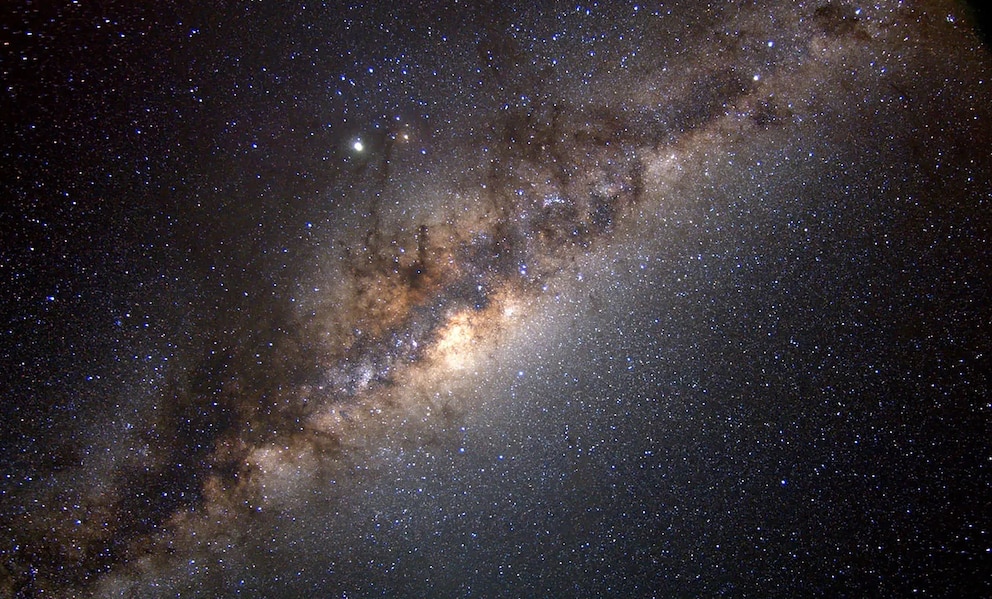
Gravitational microlensing is a "rare phenomenon," the researchers said. There have only been three such cases of a planet being documented by microlensing in the history of observations, the researchers said. Astronomers search for a temporary light "pulsation" when analyzing a vast amount of data.
The vast majority of observed stars -- about 90% -- pulsate for "various other reasons," with a minority of cases actually showing the microlensing effect, Marius Maskoliūna, an astronomy and astrophysics researcher at Vilnius University and co-author of the study, said in a statement.
"This kind of work requires a lot of expertise, patience, and, frankly, a bit of luck," Maskoliūna said. "You have to wait for a long time for the source star and the lensing object to align and then check an enormous amount of data."
In addition, most microlensing efforts are recorded at the Galactic Center -- the densest part of the Milky Way, Edita Stonkutė, an associate professor of astronomy at Vilnius University, said in a statement. AT2021uey b was found quote far from the center, in the "galactic halo, on the outskirts of the galaxy, she said.
"This is only the third planet in observational history to be discovered so far from the Galactic bulge," Stonkutė said.
The microlensing technique is promising because it allows the detection of the "unexpected or even invisible," the researchers said.
"What fascinates me about this method is that it can detect those invisible bodies," Maskoliūna said.
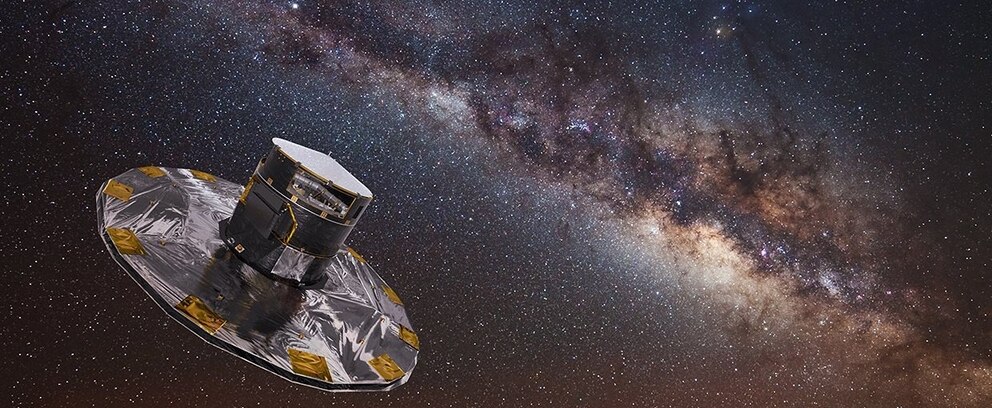
In collaboration with researchers from the Astronomical Observatory of the University of Warsaw, the researchers analyzed data from the European Space Agency's "Gaia" telescope and supplemented it with ground-based observations from telescopes at the Vilnius University's Molėtai Astronomical Observatory.
The microlensing phenomenon was first spotted in 2021, which led the astronomers on a yearslong journey to "carefully" verify the existence of the new exoplanet, according to the release.
The first discovery of an exoplanet orbiting a star was made in 1995, the researchers said. Since then, more than 6,000 exoplanets have been confirmed.
However, the science is still considered "relatively young," the researchers said.
"As data accumulated, we learned that many types of planetary systems are completely unlike ours -- the Solar System," Stonkutė said. "We've had to rethink planetary formation models more than once."