• Video
  • Shop
  • Culture
  • Family
  • Wellness
  • Food
  • Living
  • Style
  • Travel
  • News
  • Book Club
  • Newsletter
  • Privacy Policy
  • Your US State Privacy Rights
  • Children's Online Privacy Policy
  • Interest-Based Ads
  • Terms of Use
  • Do Not Sell My Info
  • Contact Us
  • © 2026 ABC News
  • News

Scientists Discover Human-Sized Lobster That Lived Half-a-Billion Years Ago
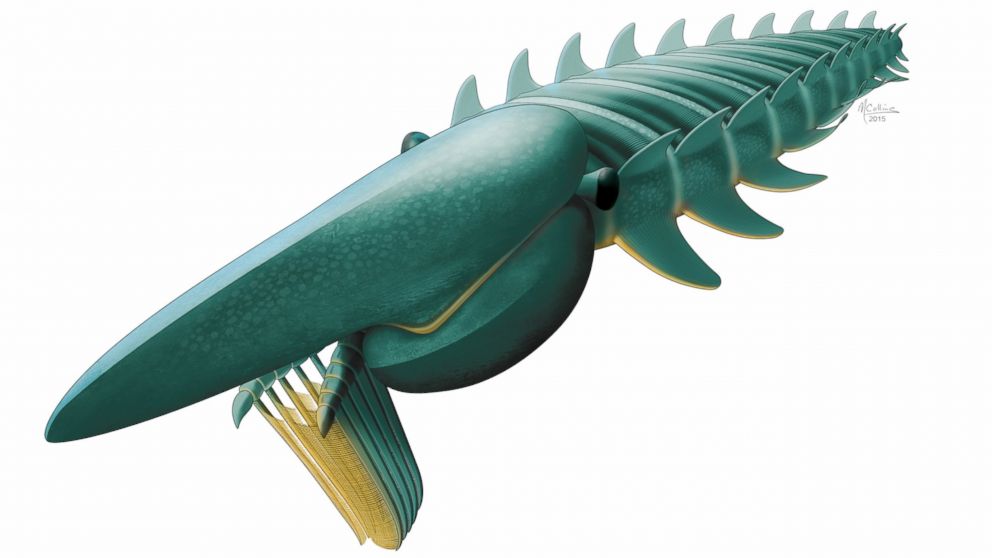
This artist's rendering provided by Marianne Collins shows the filter-feeding anomalocaridid Aegirocassis benmoulae from the Early Ordovician (ca 480 million years old) of Morocco feeding on a plankton cloud.
Marianne Collins/ArtofFact/AP Photo
ByALYSSA NEWCOMB
March 12, 2015, 5:05 PM

— -- Scientists have discovered a human-sized lobster relative that lived half-a-billion years ago, shedding new light on how crustaceans, spiders and insects evolved over time.

The well-preserved fossilized remains of one of the beastly creatures was found in Morocco and studied by scientists from Oxford and Yale Universities who published their findings in the journal "Nature."

Related Articles

Discovery of Bacteria That Hasn't Evolved in 2 Billion Years Is New Validation of Darwin's Theory

Related Articles

Scientists Crack the Code on How to Un-Boil a Hard-Boiled Egg

Related Articles

New Clues on How Black Holes Grow

Stretching nearly two meters long, the giant lobster-like species, named Aegirocassis benmoulae used its spine-covered limbs to scrape food from the ocean floor.

"These animals are filling an ecological role that hadn't previously been filled by any other animal," Allison Daley a co-author of the study and a professor at Oxford University’s Department of Zoology, said in a statement.

"While filter feeding (filtering water to find food) is probably one of the oldest ways for animals to find food, previous filter feeders were smaller, and usually attached to the sea-floor," she said. "We have found the oldest example of gigantism in a freely swimming filter feeder."

The species also has pairs of swimming flaps on both sides of its body, something scientist said was likely a precursor to the double-branched legs seen today on related arthropods, such as spiders.

The lobster-like animal was a member of a now-extinct family of marine arthropods called anomalocaridids, which first appeared 520 million years ago during the Cambrian era.


Up Next in News—

'Cheers' director James Burrows dies at 85

June 20, 2026

Anne Hathaway reveals pregnant with 3rd child, baby bump in new Instagram video

June 19, 2026

'Grandmother of Juneteenth' Opal Lee says efforts are being made to erase Black history

June 19, 2026

Barack, Michelle Obama reflect on new presidential center, greatest White House legacy

June 18, 2026

Shop GMA Favorites

ABC will receive a commission for purchases made through these links.

Sponsored Content by Taboola

The latest lifestyle and entertainment news and inspiration for how to live your best life - all from Good Morning America.
  • Contests
  • Terms of Use
  • Privacy Policy
  • Do Not Sell My Info
  • Children’s Online Privacy Policy
  • Advertise with us
  • Your US State Privacy Rights
  • Interest-Based Ads
  • About Nielsen Measurement
  • Press
  • Feedback
  • Shop FAQs
  • ABC News
  • ABC
  • All Videos
  • All Topics
  • Sitemap

© 2026 ABC News
  • Privacy Policy— 
  • Your US State Privacy Rights— 
  • Children's Online Privacy Policy— 
  • Interest-Based Ads— 
  • Terms of Use— 
  • Do Not Sell My Info— 
  • Contact Us— 

© 2026 ABC News