'Fossil' object dubbed 'Ammonite' discovered on the outskirts of the solar system
Astronomers have discovered a "fossil" body residing on the outskirts of the solar system, according to new research.
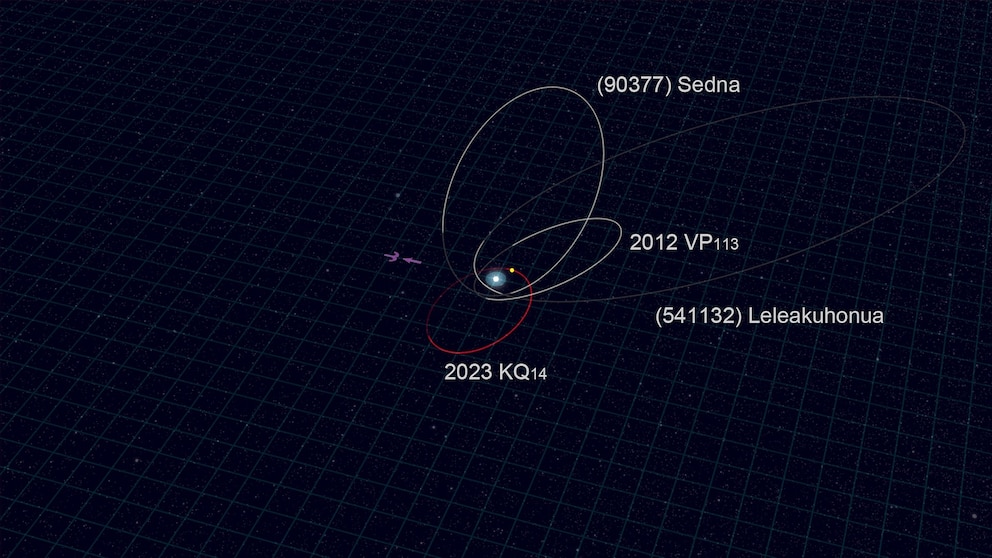
The object – which goes by the formal designation 2023 KQ14 but is nicknamed “Ammonite," in an apparent nod to the widely found, ancient fossilized mollusk – was detected by the Subaru Telescope in Hawaii, according to a paper published Tuesday in Nature Astronomy.
Ammonite was discovered at its perihelion, which is the point in a celestial body's orbit at which it is closest to the sun, according to the paper. It lies beyond Pluto at a distance of 71 AU, or astronomical units – putting it 71 times the average distance between the sun and Earth, according to the National Astronomical Observatory of Japan (NAOJ), whose astronomers made the discovery.
The object was found in a region so far on the solar system's outskirts that gravity from Neptune, the planet farthest away from the sun in our solar system, has little influence on it, Fumi Yoshida, a planetary scientist at the NAOJ and co-author of the paper, said in a statement.
Such objects are technically known as sednoids. Ammonite is only the fourth-ever sednoid to be discovered, the researchers said.
"The presence of objects with elongated orbits and large perihelion distances in this area implies that something extraordinary occurred during the ancient era when 2023 KQ14 formed," Yoshida said. "Understanding the orbital evolution and physical properties of these unique, distant objects is crucial for comprehending the full history of the solar system."
Astronomers first noticed the object several times in 2023 and confirmed its existence with follow-up observations in 2024 by the Canada-France-Hawaii Telescope in Hawaii, according to NAOJ. Astronomers were also able to track the object's orbit over 19 years by studying old data from other observatories.
Ammonite has maintained a stable orbit for at least 4.5 billion years but its current orbit differs from those of the other known sednoids, according to the paper.
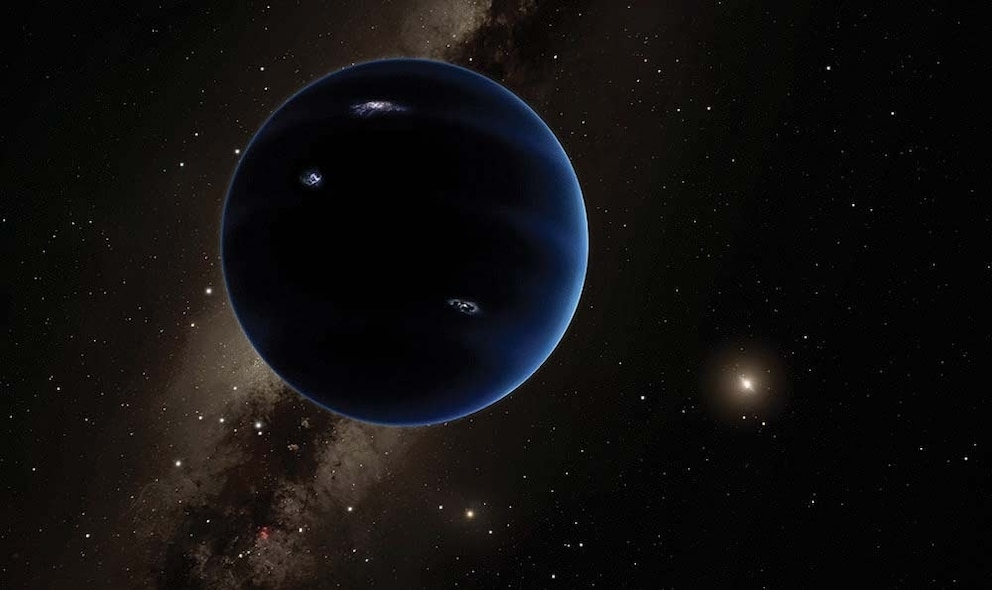
The discovery indicates that the outer solar system is more diverse and complex than previously thought, according to NAOJ. In addition, the existence of Ammonite again calls into question the existence of a possible Planet Nine, a long-hypothesized ninth planet in the solar system that some say could explain the orbits of other distant objects through its gravitational influence, should it exist.
"The fact that 2023 KQ14’s current orbit does not align with those of the other three sednoids lowers the likelihood of the Planet Nine hypothesis," said Yukun Huang, an astronomer at the NAOJ and co-author of the paper. "It is possible that a planet once existed in the solar system but was later ejected, causing the unusual orbits we see today."
Ammonite was found as part of the FOSSIL survey project, which stands for the Formation of the Outer Solar System: An Icy Legacy, according to NAOJ. A more classical name will be assigned to the object by the International Astronomical Union at a later date, the researchers said.
The Subaru Telescope is among the few telescopes on Earth capable of making such a discovery, according to the researchers.
"I would be happy if the FOSSIL team could make many more discoveries like this one and help draw a complete picture of the history of the Solar System," Yoshida said.