NASA detects rare phenomenon of a black hole 'devouring' a star with help of AI
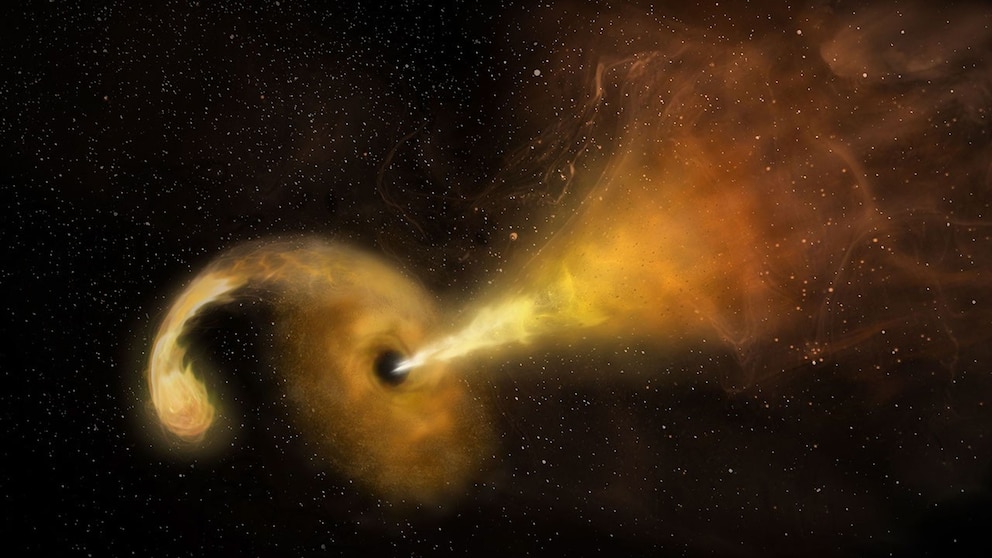
Astronomers have captured a rare image of the flare from a black hole "devouring" a star on the outskirts of a faraway galaxy, NASA said.
The event involved an "orphan" black hole lighting up as it shredded a nearby star apart, a phenomenon known as a tidal disruption event (TDE), according to a paper published Monday in The Astrophysical Journal Letters. The "monster" black hole weighs about a million times as much as the sun and is located about 750 million light-years away from Earth, NASA noted.
These types of black holes are described as "orphan" or "wandering" black holes because they are located on the outskirts of a galaxy rather than in the center. The researchers theorize that the black hole ended up so far from the galaxy's center due to one of two possibilities.
It may have resulted from the merger of multiple galaxies, when three or more galaxies may have merged together and the gravitational tug-of-war between their central supermassive black holes may have flung the lightest black hole out to the galaxy's edge -- in this case about 30,000 light-years away from the center, according to NASA.
The other possibility is that a dwarf galaxy is still in the process of merging with the larger one, and a star drifted too close to the dwarf's own supermassive black hole as its stars were pulled inward.
During a TDE, the supermassive black hole's intense gravity overcomes the star's own gravity, pulling it apart and unleashing an ultrabright flare, NASA said. This is the first optical TDE discovered in the outskirts of a host galaxy, according to the paper.
Scientists first detected an unusual brightening in November 2025 by the Zwicky Transient Facility, a survey conducted by the Palomar Observatory in Southern California.
Out of the half million flashes detected each night, a new artificial intelligence algorithm automatically recognized a flare that looked like a TDE, said Robert Stein, a research fellow at The University of Maryland, College Park and NASA's Goddard Space Flight Center, in a statement.
The TDE was so bright that it outshone its entire host galaxy in ultraviolet wavelengths for months, temporarily radiating with the light of about 10 billion suns, according to NASA.
Astronomers then used the Southern Astrophysical Research (SOAR) telescope in Chile and NASA's Neil Gehrels Swift Observatory satellite to confirm the existence of the TDE.
"The combination of all this data helped us rule out other explanations and confidently say it's a tidal disruption event, despite its strange location," said Jonathan Carney, a doctoral student at the University of North Carolina at Chapel Hill, in a statement. Carney took the first spectra that supported the flare's interpretation as a TDE, according to NASA.
A TDE itself is rare and had never before been witnessed so far outside of the galaxy's core, NASA noted. A star will drift too close to a supermassive black hole about once every 100,000 years, the space agency said.
Scientists have been scouring millions of galaxies looking for orphan black holes, NASA said. Prior to 2024, they had only been witnessed in galaxy centers, primarily because that's the only place researchers were looking for them, according to the space agency.
Once astronomers witnessed the "tell-tale" signs of a star-shredding event happening about 2,600 light-years away from the center of its host galaxy in May 2025, it inspired more research for similar event outside the galaxy core.
Locating these TDE events could lead scientists to finding more of these giant, invisible black holes, according to Stein, lead author of the paper.
"We were looking for these star-shredding events as a way to find otherwise invisible supermassive black holes wandering away from the galactic cores where they usually reside," Stein said. "With this discovery, which is one of just a couple that have been confirmed so far, we've validated a new technique and can use it to hunt for more."